

- Startseite
- Funktionen
- Windows, Mac und Linux
Für Windows und Linux. Auch auf dem Mac.
VDM is built for 64-bit Windows 10 and 11, as an installer, a portable copy or a plain zip, and for Linux, checked on four desktops. Experimental builds for macOS come with every release too.
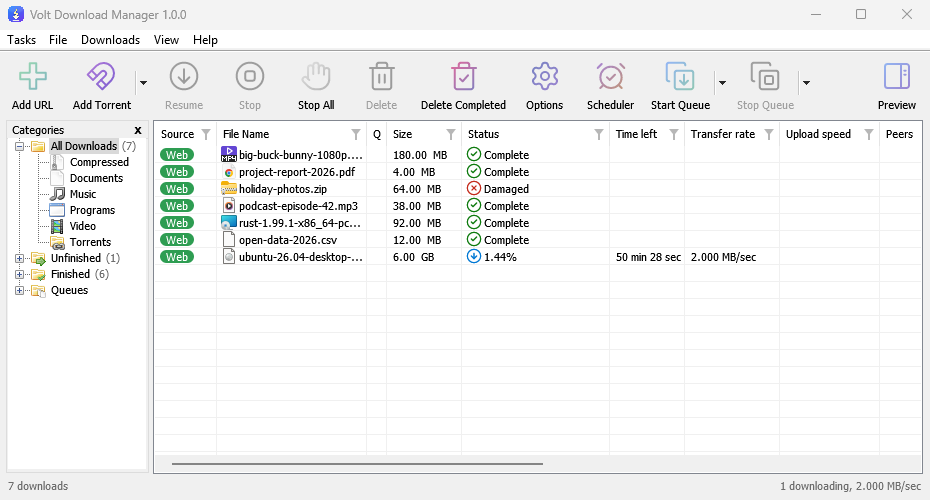
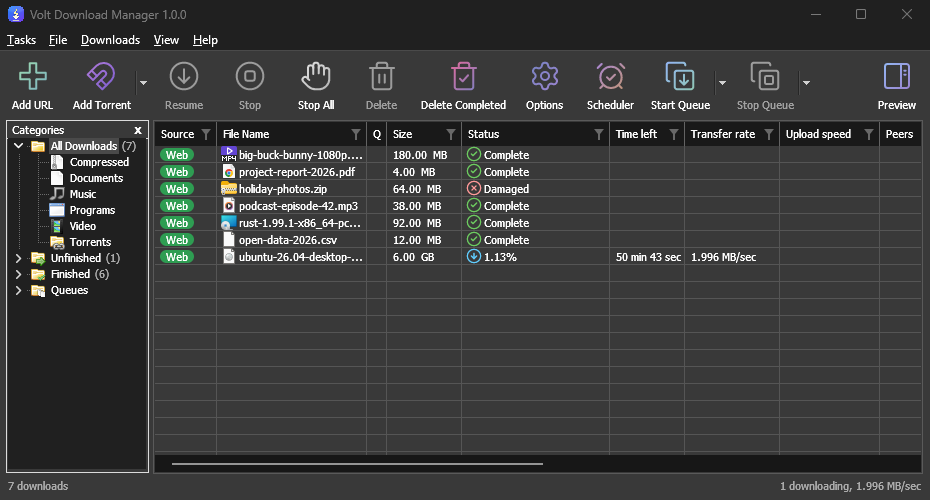
Windows: drei Installationsarten
On 64-bit Windows 10 and 11, VDM is the stable, recommended build. The download page offers three files:
- The installer (
setup.exe), the one to pick unless you have a reason not to. It installs for you alone without administrator rights, or for everyone, and can set up browser integration and open.torrentfiles and magnet links with VDM. - Die portable Version (
portable.zip), die von jedem Ordner aus läuft. - Das einfache Zip-Archiv (
x64.zip), die gleichen Programme ohne Installer.
Hilfe → Nach Updates suchen → Jetzt aktualisieren lädt eine neue Version herunter, prüft deren Signatur, installiert sie und startet neu, sowohl für den Installer als auch für die beiden Zip-Versionen.
Windows on ARM und 32-Bit-Windows
From version 0.6.0, the three files come for two more kinds of PC, with the processor
in their names: Windows on ARM (setup-arm64.exe, portable-arm64.zip, arm64.zip), for
PCs with a Snapdragon or another ARM processor, which then run VDM without Windows translating it;
and 32-bit Windows 10 (setup-x86.exe, portable-x86.zip, x86.zip). Update now keeps
each copy on its own processor's files. VDM downloads yt-dlp's own build for each, and ffmpeg's
for Windows on ARM; no ffmpeg is built for 32-bit Windows that VDM can check, so there you choose
your own in Helpers... for the best video qualities. Linux gets its four files for 64-bit
ARM computers too (linux-arm64).
Portable Version: alles in einem Ordner
Unzip the portable copy anywhere, a USB stick included. The download list, the settings, the
video helpers and torrent data stay in a data folder next to the program, and nothing is
written to the registry. Two things need the installer instead: starting with Windows, and
taking downloads from the browser, since both go through the registry. Carry VDM on a USB
stick shows the set-up.
Mac und Linux: Was Sie bekommen
Für Linux auf x86-64 (und ARM64 ab Version 0.6.0): ein AppImage für die meisten Distributionen, eine .deb für Ubuntu, Debian, Mint und Pop!_OS, eine .rpm für Fedora, openSUSE und RHEL, und eine .tar.gz der reinen Programme. Für macOS 11 und neuer, auf Apple Silicon oder Intel, sind .dmg Dateien noch als -experimental gekennzeichnet. Bitte teilen Sie uns mit, wie es gelaufen ist, ob gut oder schlecht.
There, VDM connects itself to your browsers at each start, has its tray icon, follows the
system's light or dark look and uses the system's fonts and ffmpeg. Running downloads show their
progress on VDM's icon, as on the Windows taskbar: in the macOS Dock, and in Linux docks that
can show it (Ubuntu Dock, Dash to Dock, KDE Plasma's task manager). The Mac app isn't notarized
by Apple yet, so macOS asks before its first start: right-click it and choose Open (on
macOS 15 and later, System Settings → Privacy & Security → Open Anyway). A .deb or .rpm
update opens in the system's installer. A few parts work only on Windows, and the help says so
where it matters.
Linux, auf vier Desktops geprüft
Linux isn't experimental any more, since version 0.5.0: every change is checked on a Linux
desktop as well as on Windows. GNOME, KDE Plasma, Xfce and Cinnamon were checked window by window: the tray icon and
its menu, Minimize to the notification area, Dark Mode support following the desktop, and the
browsers handing downloads over (Ubuntu's Snap Firefox, Google Chrome and Brave). A Wayland
session runs VDM through XWayland, so menus open under their titles, on tiling compositors such
as sway too. The .deb and .rpm were installed in clean Ubuntu 24.04, Debian 12 and Fedora 45
systems and bring everything VDM needs; from the AppImage or the .tar.gz, a missing library is
named at start with the command that installs it. Update now asks the package manager which
package VDM is.
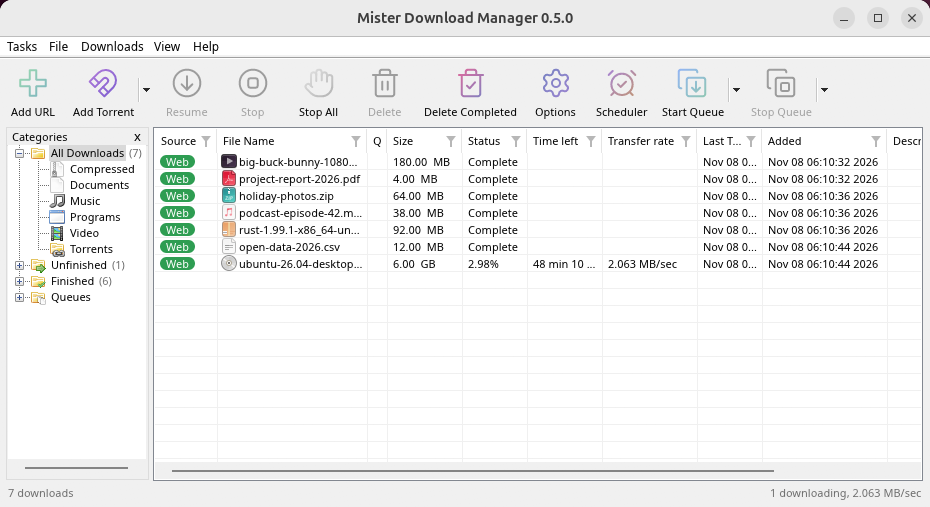
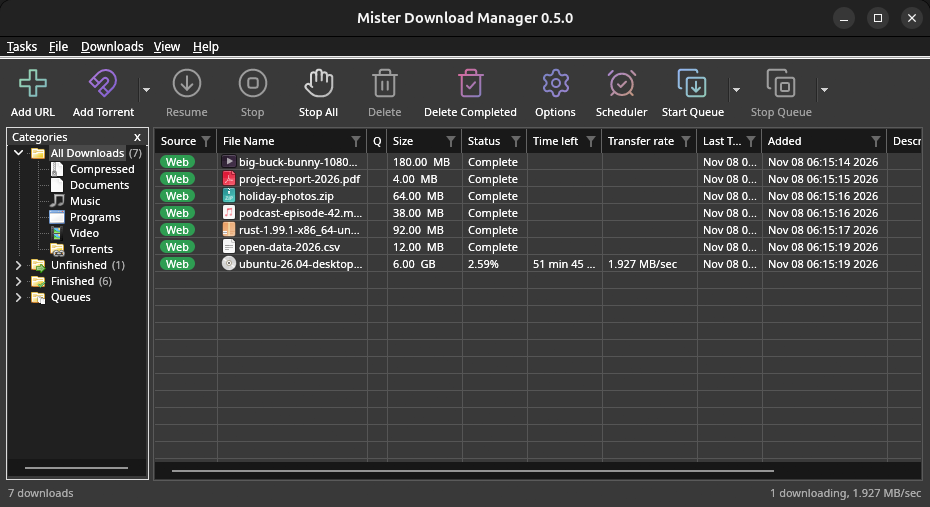
What's left: the Flatpak Firefox isn't checked yet; screen readers (Orca) don't read VDM's windows on Linux yet; and native Wayland windows can't place menus, so XWayland stays the default. macOS stays experimental: its builds are made and tested by GitHub Actions, not yet on a Mac of ours.
Kleinere Mac-Downloads, leichtere Linux-Updates
The Mac gets two smaller downloads, one for Apple Silicon and one for Intel, instead of one
universal .dmg of 80 MB. From 0.2.4 or older, update the Mac once by hand: Download in
Check for updates opens the release, where you pick your Mac's file. The AppImage can update
through AppImageLauncher, Gear Lever and AppImageUpdate, which fetch only the parts that changed.
Linux can draw with Vulkan and macOS with Metal, from View → Draw with, while OpenGL stays the
default there. In a Wayland session, VDM runs through XWayland so its menus open where you click.
Kostenlos, Open Source, keine Werbung, keine Testversion.
Download Volt Download Manager