

VDM runs on Windows 10 and Windows 11 (x64, ARM64 and 32-bit), and on 64-bit Linux (x86-64 and ARM64): see On Linux. Builds for macOS are new and still experimental: see On a Mac.
Einen Download auswählen
Jede Version finden Sie auf der Seite Releases. Für Windows gibt es drei Dateien:
| Datei | Was es ist |
|---|---|
VoltDownloadManager-<version>-setup.exe |
The installer. Pick this one unless you have a reason not to. It can set up browser integration and open .torrent files and magnet links with VDM. |
VoltDownloadManager-<version>-portable.zip |
Eine portable Kopie. Die Download-Liste und die Einstellungen bleiben in einem data-Ordner neben dem Programm, und es wird nichts in die Registrierung geschrieben. Die Browser-Integration erfordert das Installationsprogramm. Siehe Portabler Modus. |
VoltDownloadManager-<version>-x64.zip |
Die gleichen Programme ohne Installationsprogramm. Es speichert seine Daten in %APPDATA%\voltdownloadmanager, wie eine installierte Kopie. |
Diese drei sind für 64-Bit-Windows auf einem Intel- oder AMD-Prozessor (x64), dem üblichen PC. Ab Version 0.6.0 gibt es jede auch für zwei weitere PC-Arten, mit dem Prozessor im Namen:
| Dateien | Für |
|---|---|
...-setup-arm64.exe, ...-portable-arm64.zip,...-arm64.zip |
Windows auf ARM (PCs mit Snapdragon- oder anderem ARM-Prozessor). Unter Windows 11 laufen die x64-Dateien dort auch, von Windows übersetzt, aber langsamer. Die ARM64-Installation über der x64-Installation ersetzt diese; Ihre Liste und Einstellungen bleiben erhalten, da sie in Ihrem Profil gespeichert sind, nicht im Programm. |
...-setup-x86.exe, ...-portable-x86.zip,...-x86.zip |
32-bit Windows 10. Not sure which you have? Settings → System → About → System type says it. VDM can't download ffmpeg for you there (none is built for 32-bit Windows that VDM can check): to get the best video qualities, choose an ffmpeg of your own in Helpers... (Video). |
Hilfe → Nach Updates suchen aktualisiert jede Kopie auf die Dateien für ihren eigenen Prozessor.
Mit WinGet
VDM is also in WinGet, Windows' package manager. In a terminal, the first line installs VDM and the second updates it to the latest version:
winget install MikaiL.VoltDownloadManager
winget upgrade MikaiL.VoltDownloadManager
WinGet downloads the setup and installs VDM without the setup's questions.
Unter Linux
VDM runs on 64-bit Linux with a desktop session. It is tested on Ubuntu 24.04, Debian 12 and
Fedora, with GNOME, KDE Plasma, Xfce and Cinnamon, on X11 and in Wayland sessions. Pick one
of these files (up to version 0.2.4, their names end in -experimental, as in
...-linux-x86_64-experimental.deb). From version 0.6.0, each also comes for 64-bit
ARM computers, with arm64 in place of x86_64 (...-linux-arm64.deb); they are built and
tested on GitHub's ARM machines. On ARM, VDM doesn't download gallery-dl itself (its author
builds none for it): install it with your system's packages or pip.
| Datei | Was es ist |
|---|---|
...-linux-x86_64.deb |
For Ubuntu, Debian, Mint and Pop!_OS: sudo apt install ./<file>.deb. It brings the libraries VDM needs. |
...-linux-x86_64.rpm |
For Fedora, openSUSE and RHEL: sudo dnf install ./<file>.rpm. It brings the libraries VDM needs. |
...-linux-x86_64.AppImage |
Läuft auf den meisten Distributionen: ausführbar machen (chmod +x) und ausführen. Es aktualisiert sich selbst (Hilfe → Nach Updates suchen). |
...-linux-x86_64.tar.gz |
Die reinen Programme, für jede Distribution. |
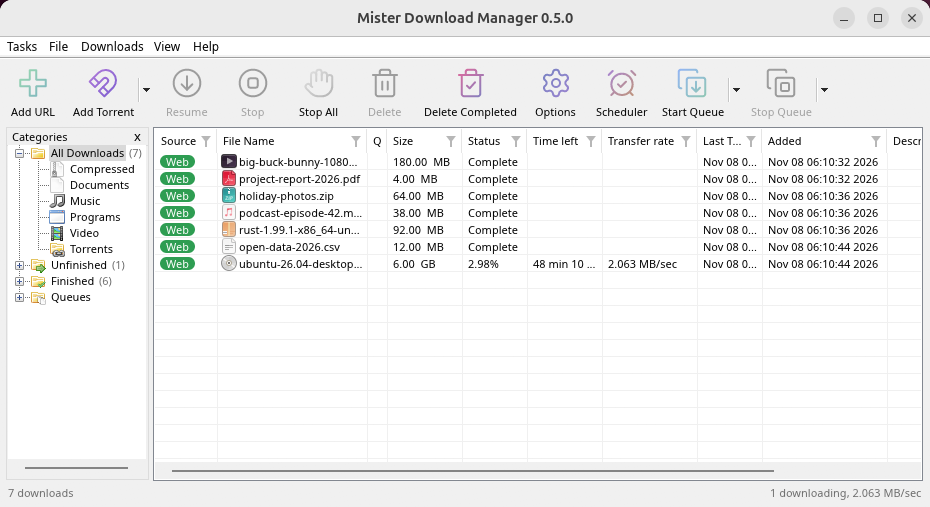
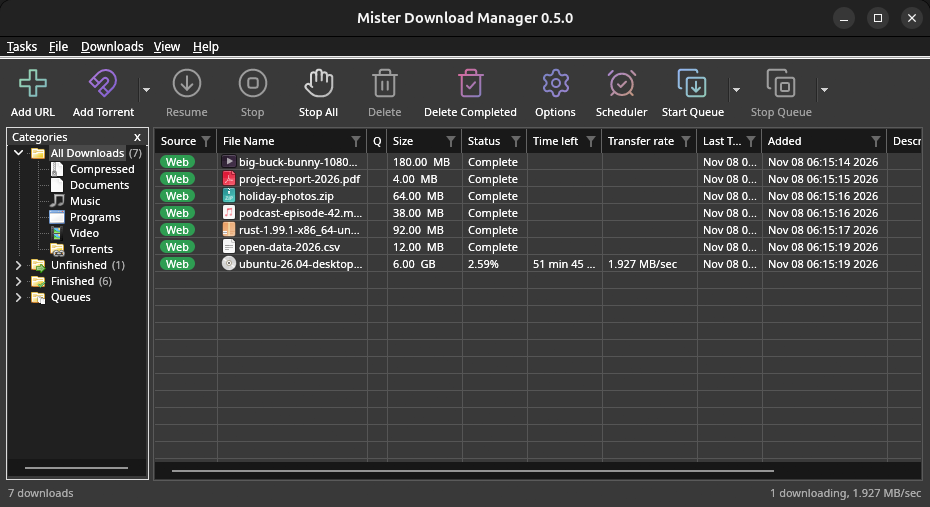
Browser integration is set up by VDM itself at each start (the browsers installed then are found); add the extension as in Browser integration. Firefox installed as a Snap (Ubuntu's) reaches VDM once you allow it; other Snap and Flatpak browsers can't (see Flatpak and Snap browsers). The tray icon, Dark Mode support and Launch on startup work on GNOME (Ubuntu's), KDE Plasma, Xfce and Cinnamon. Running downloads show their progress on VDM's icon in docks that can show it, such as Ubuntu Dock and KDE Plasma's task manager, as on the Windows taskbar (more).
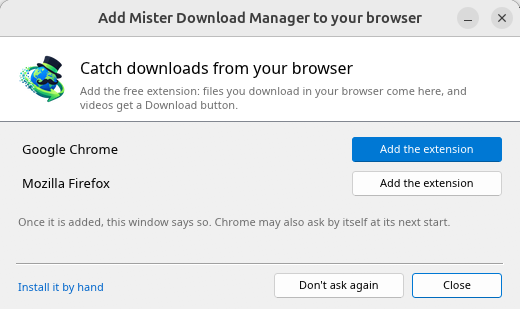
In a Wayland session the windows go through XWayland or Wayland (below). Not there yet on Linux: screen readers (Orca) don't read VDM's windows; browsers installed as a Flatpak can't reach VDM (Firefox from Flathub may, through the desktop as the Snap does, but that isn't checked yet); and View → Draw with → Vulkan is a choice, OpenGL stays the default.
In a Wayland session, VDM chooses its windows' system as it starts, the same way however it was started (its menu entry, the browser's helper, the session's autostart). Its windows run through XWayland where X11 programs look right: only X11 lets VDM open its menus and drop-down lists right under what you clicked (on Wayland they open where the compositor puts new windows, often the middle of the screen) and hide its window in the notification area. That is GNOME and KDE Plasma, which tell X11 programs the screen's scale, and any desktop whose screens aren't scaled. On a scaled screen where nothing tells X11 programs the scale (Hyprland, labwc, sway and other wlroots compositors), the compositor would scale VDM's windows up, blurry, so VDM uses Wayland's own windows there. View → Window system picks X11 (XWayland) or Wayland instead, from the next start, for every way VDM starts (Automatic goes back to VDM's choice); VDM_WAYLAND=1 or VDM_WAYLAND=0 decides for one start. If the system lacks a library X11 windows need (such as libxkbcommon-x11, which the .deb and .rpm bring but the AppImage and the tar.gz can't), VDM opens on Wayland instead; with no window system it can use, it names what's missing and the command that installs it.
Die Fenster sind die in dieser Hilfe beschriebenen, mit den Schriftarten, Dateisymbolen und Titelleisten des Desktops:
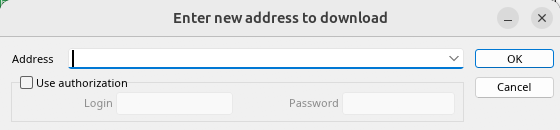
URL hinzufügen. 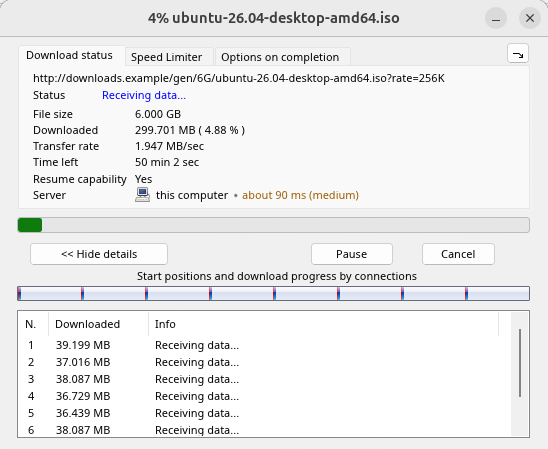
Der Fortschritt eines Downloads. 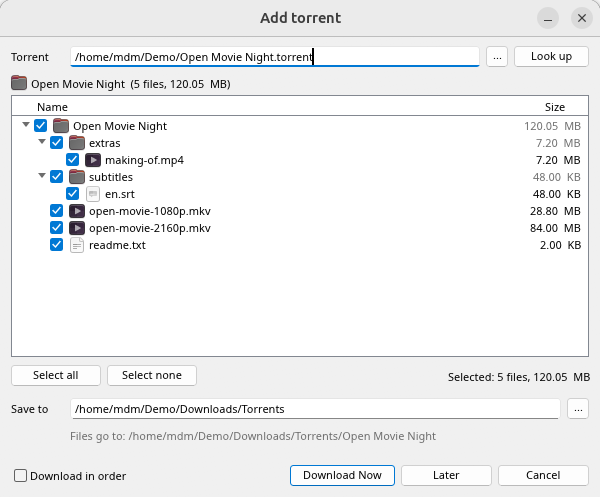
Torrent hinzufügen. 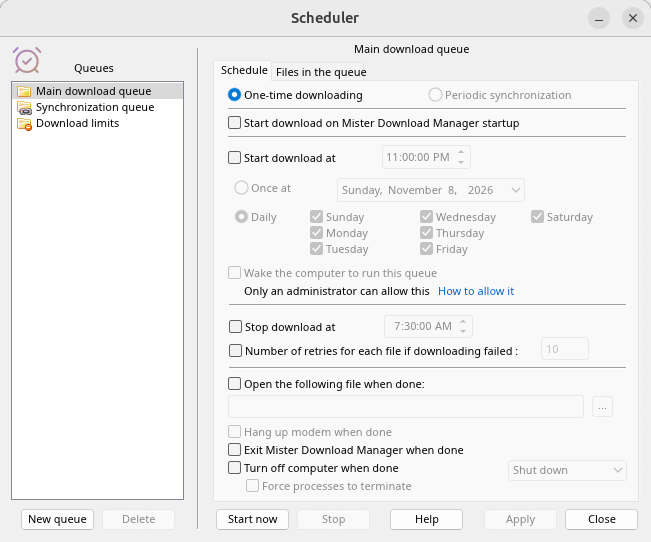
Der Zeitplaner. 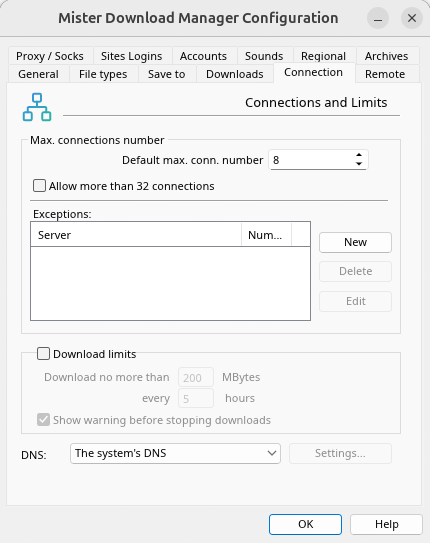
Optionen.
Und auf den anderen Desktops, auf denen es getestet wurde:
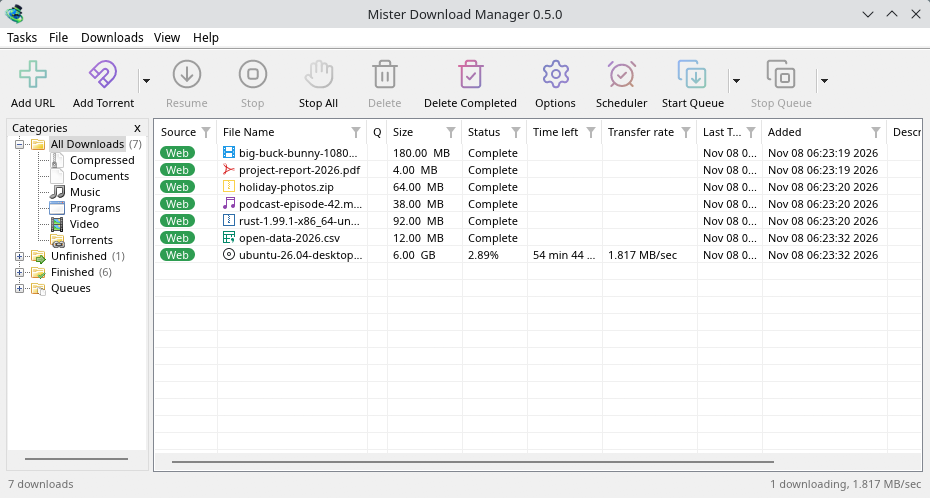
KDE Plasma. 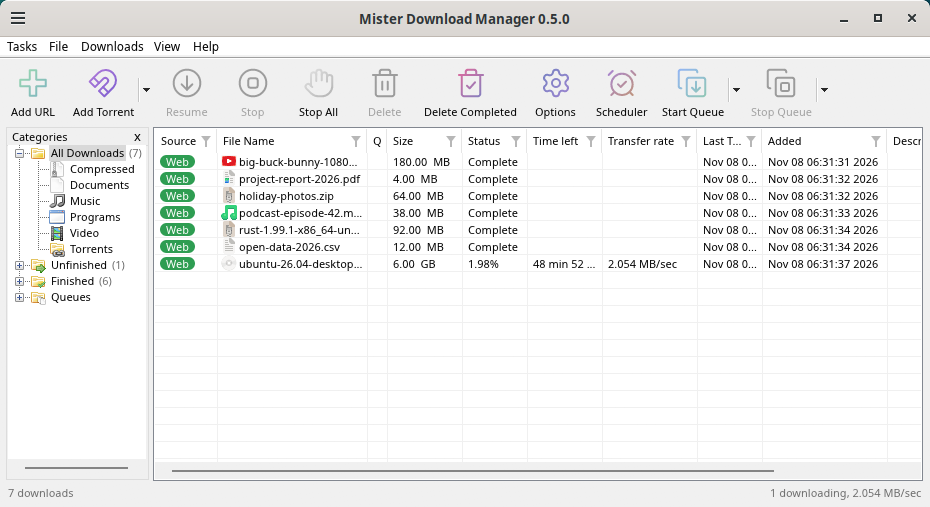
Cinnamon. 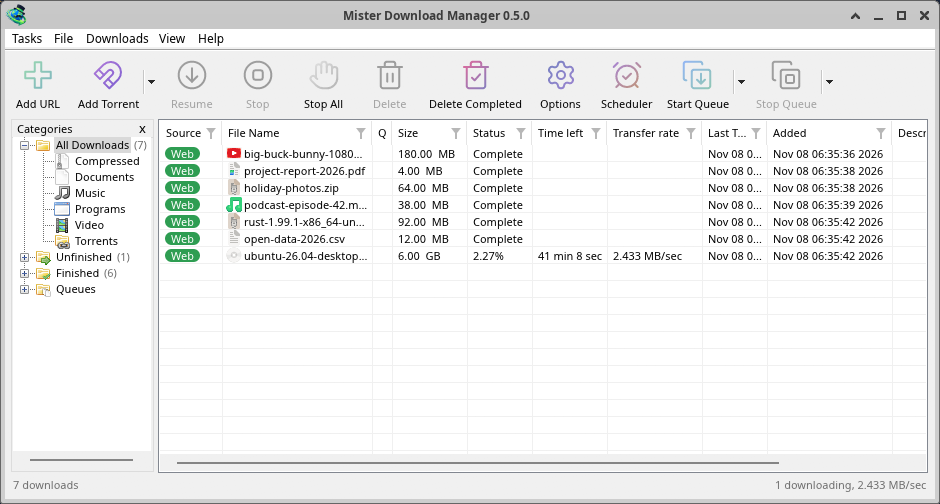
Xfce.
Deinstallieren unter Linux
sudo apt remove voltdownloadmanager (or sudo dnf remove voltdownloadmanager) removes the
programs, and the small files that tell your browsers where VDM's helper is: the .deb and .rpm
install those for everyone (in /etc and /usr/lib), for Chrome, Chromium, Edge, Brave, Vivaldi,
Helium and Firefox (the Snap too), so VDM doesn't write them in your home folder. For the AppImage
or the tar.gz, delete the file or the folder.
What VDM keeps in your home folder stays, as with any package: your list and settings
(~/.local/share/voltdownloadmanager), the AppImage's and the tar.gz's browser files, and
those of the browsers that read them only there (Opera, Helium, Thorium, and Firefox's forks:
Zen, LibreWolf, Floorp, Waterfox). A package can't remove those: it never touches
home folders. Without VDM they lead nowhere, so the extension says it can't reach VDM. To remove
them as well, run this as each user who used VDM, before uninstalling:
voltdownloadmanager-nmhost --unregister
(Vom AppImage: ~/.local/share/voltdownloadmanager/browser-host/voltdownloadmanager-nmhost --unregister.) Bereits deinstalliert? Dies entfernt dieselben Dateien:
find ~/.mozilla ~/.librewolf ~/.config -name com.voltdownloadmanager.host.json -delete 2>/dev/null
Auf einem Mac
Die macOS-Builds sind neu und noch experimentell: Wir haben sie selbst noch nicht auf einem Mac ausprobiert, Sie wären also unter den Ersten. Bitte teilen Sie uns mit, wie es gelaufen ist, ob gut oder schlecht.
| Datei | Was es ist |
|---|---|
...-macos-arm64-experimental.dmg |
For a Mac with Apple Silicon (M1 or later: Apple menu → About This Mac shows a Chip). Open it and drag Volt Download Manager to Applications. macOS asks before its first start, because the app isn't notarized by Apple: right-click it and choose Open (on macOS 15 and later: System Settings → Privacy & Security → Open Anyway). |
...-macos-x86_64-experimental.dmg |
Dasselbe für einen Mac mit Intel-Prozessor (Über diesen Mac zeigt einen Prozessor an). |
Browser integration is set up by VDM itself at each start (the browsers installed then are found); add the extension as in Browser integration.
Installation mit dem Setup
- Führen Sie
VoltDownloadManager-<version>-setup.exeaus. - Choose the language. Windows' display language is already selected. The setup offers every language VDM has, and VDM starts in the one you pick.
- Wählen Sie, ob die Installation nur für Sie oder für alle Benutzer des Computers erfolgen soll. „Nur für Sie“ benötigt keine Administratorrechte und wird unter
%LOCALAPPDATA%\Programs\Volt Download Managerinstalliert. „Für alle“ wird unterProgram Filesinstalliert. - Pick what the setup should do: - Set up browser integration (Chrome, Edge, Brave, Firefox) - Open .torrent files and magnet links with Volt Download Manager - Start Volt Download Manager when Windows starts - Create a desktop shortcut (off unless you tick it)
- Click Install, then Finish to start VDM.
If VDM is already running, the setup asks it to save and close first. To update, use Help → Check for updates → Update now, or run the setup of the new version (or update with WinGet); your list and settings stay.
Die Browser-Integration erfordert in jedem Browser einen weiteren Schritt: das Hinzufügen der Erweiterung. Klicken Sie in Firefox auf Zu Firefox hinzufügen auf der Seite unter addons.mozilla.org; in Chrome, Edge, Brave, Opera und Vivaldi auf Zu Chrome hinzufügen auf der Seite im Chrome Web Store. Browser-Integration zeigt, wie es geht.
Deinstallieren
Uninstall VDM from Windows Settings → Apps. The uninstaller asks whether to delete your download list and settings too. Your downloaded files are never touched.
Eine Zip-Kopie verwenden
- Entpacken Sie die Datei in einen Ordner, in den Sie schreiben können (nicht direkt in
Program Files). - Führen Sie
voltdownloadmanager.exeaus.
Die ZIP-Dateien enthalten dieselben Programme wie das Setup: die App, voltdownloadmanager-cli.exe (Downloads über die Befehlszeile; siehe Befehlszeile und Automatisierung) und den Ordner extension.
Erster Start und Sprache
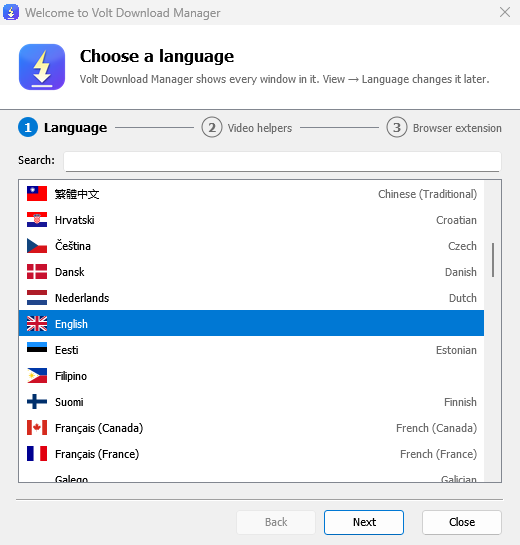
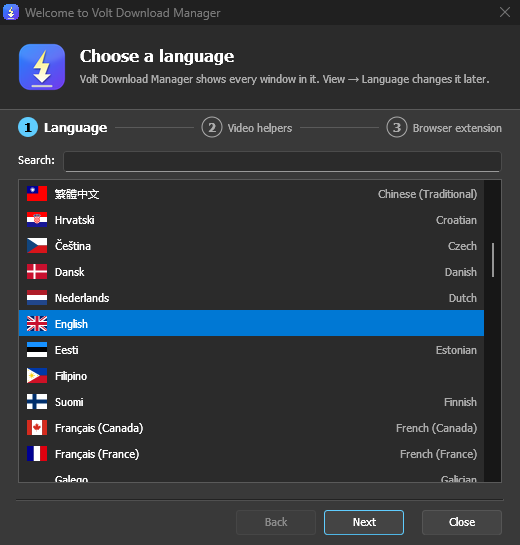
On its first start VDM opens one Welcome to Volt Download Manager window that walks you through what it needs, a step at a time: the steps are named on top, Back and Next move between them, and Finish on the last one closes it. Each step can be passed with Next without doing anything, Close or the window's × ends the setup at any step, and once it is finished or closed it doesn't come back: everything in it stays in the menus. Steps that aren't needed are left out.
- Language. - Installed with the setup: VDM starts in the language you chose in the setup, and this step is left out. - Otherwise: the list of languages, each with its flag and its own name. Click yours: the window switches to it at once, right to left for Arabic, Hebrew, Persian and Urdu.
Sie können die Sprache jederzeit unter Ansicht → Sprache ändern. Mehr dazu unter Sprachen.
- Video-Helfer (unten).
- Browser extension: each browser VDM found, with Add the extension for it, as in Browser integration. Left out when a browser's extension already reached VDM, or in a portable copy.
Die Video-Helfer
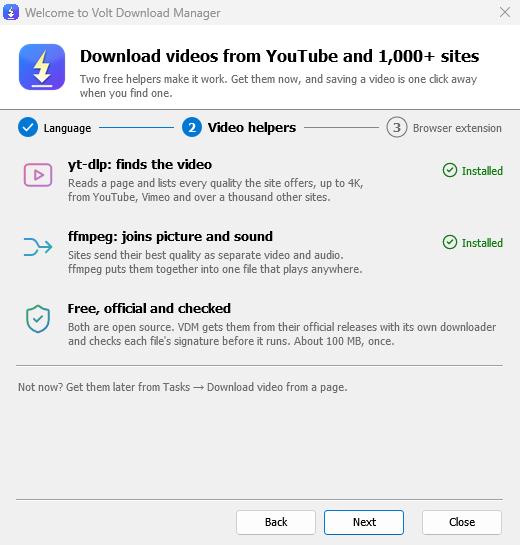
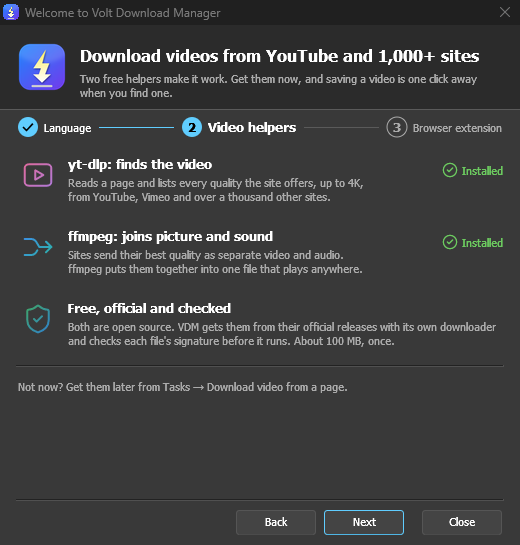
The setup's second step offers VDM's free video helpers: yt-dlp, which finds the video on a page, ffmpeg, which joins its picture and sound (on Windows; elsewhere VDM uses your system's), and Node.js, which YouTube needs, when your computer has no JavaScript runtime. Each says whether it is already there; one that isn't has its own Install button, and Yes, download them (recommended) gets every one that is missing. They download in the background, about 100 MB, once, each with its progress in its row, and go on if you close the window. Nothing is downloaded until you press one. Next leaves them for later: the video window offers them when you first need them. The step is left out when they are all there. More in Videos.
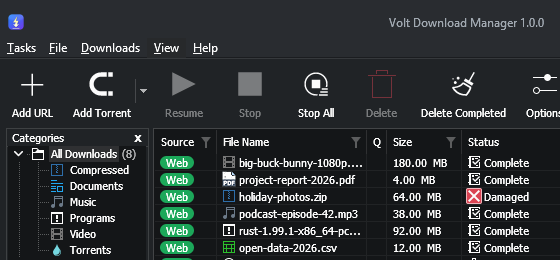
Das Hauptfenster
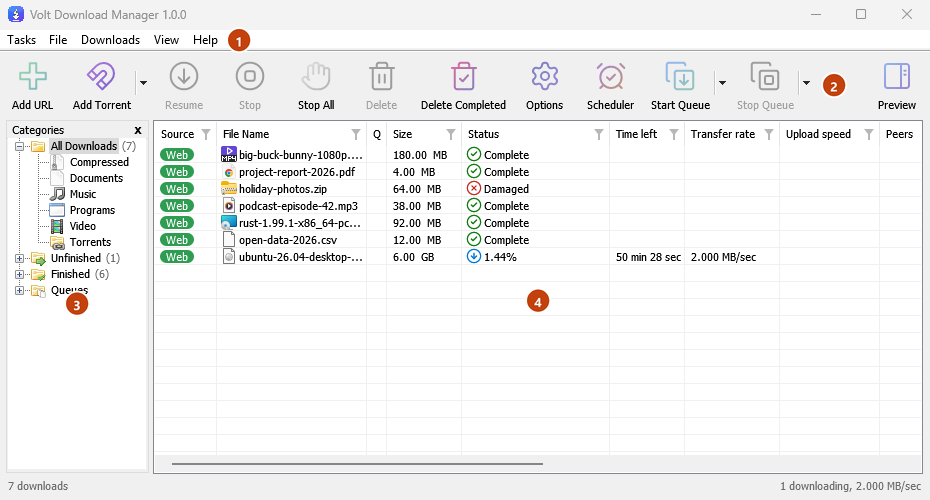
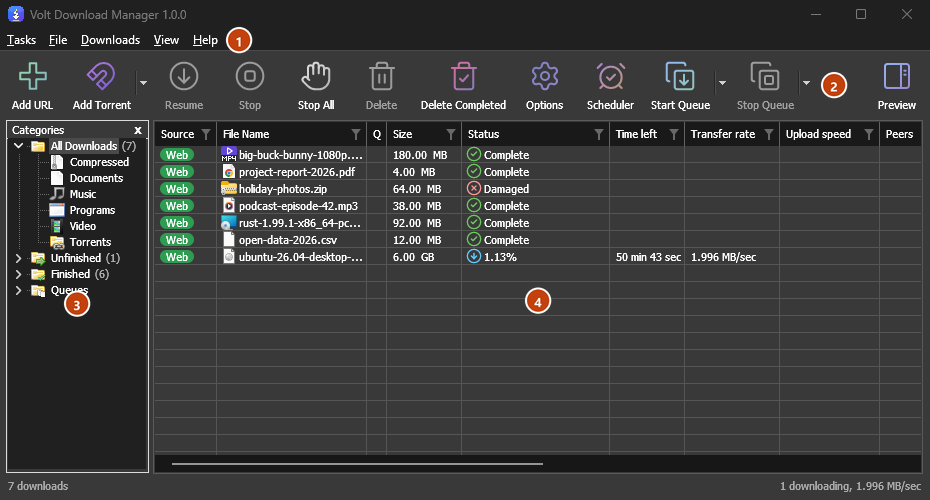
Von oben nach unten:
- Menüleiste.
- Aufgaben – Downloads, Torrents, Magnet-Links, Batch-Downloads und Videos von einer Seite hinzufügen; Torrent-Einstellungen; Link-Grabber; RSS-Feeds; das Drop-Ziel anzeigen; die Liste importieren und exportieren; beenden.
- Datei – der ausgewählte Download: Download stoppen, Entfernen, Jetzt herunterladen, Erneut herunterladen.
- Downloads – Alle anhalten, Alle stoppen, Alle abgeschlossenen löschen, Suchen, der Zeitplaner, Warteschlangen, der Geschwindigkeitsbegrenzer und Optionen.
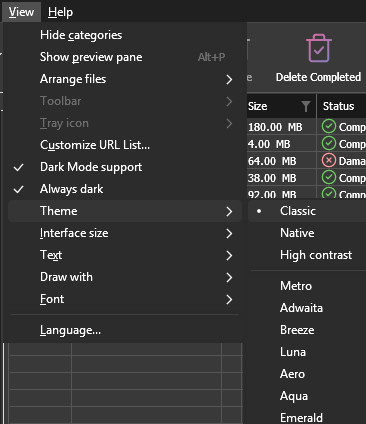
- Ansicht – Kategorien ein- oder ausblenden, Liste sortieren (Dateien anordnen), Dark Mode-Unterstützung, Immer dunkel, Design, Oberflächengröße (jedes Fenster größer, 100 % bis 200 %; auch Strg +, Strg − und Strg 0), Schriftart (eigene Schriftartdatei und Textgröße der Oberfläche, zusätzlich zur Oberflächengröße), Text (Windows: glatte oder klassische Buchstaben), Zeichnen mit (OpenGL oder Direct3D unter Windows, Vulkan unter Linux, Metal unter macOS) und Sprache.
- Help — help pages and tutorials (on the website, in your language when it has it), Keyboard shortcuts, Report a problem, Check for updates, About, Tell a friend and Support VDM (its creator's GitHub Sponsors page: optional, nothing in VDM changes).
- Symbolleiste. URL hinzufügen, Torrent hinzufügen, Fortsetzen, Stoppen, Alle stoppen, Löschen, Abgeschlossene löschen, Optionen, Zeitplaner, Warteschlange starten, Warteschlange anhalten. Der kleine Pfeil neben Torrent hinzufügen, Warteschlange starten und Warteschlange anhalten öffnet weitere Optionen.
- Kategorien (links). Wählen Sie, was die Liste anzeigt: Alle Downloads, Unvollendet, Abgeschlossen und Warteschlangen, jeweils mit ihren Kategorien. Ziehen Sie den Spalt zwischen dem Bereich und der Liste, um ihn zu verbreitern.
- Download-Liste (rechts). Eine Zeile pro Download. Siehe Die Download-Liste.
Dark Mode
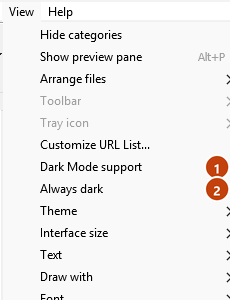
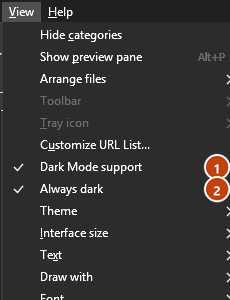
VDM follows your system: when Windows (or your desktop's light/dark preference on Linux and macOS) is set to dark mode, so is VDM. To keep VDM light whatever the system does, turn off View → Dark Mode support. To keep it dark whatever the system does, for example on a desktop that reports no preference, turn on View → Always dark.
Designs
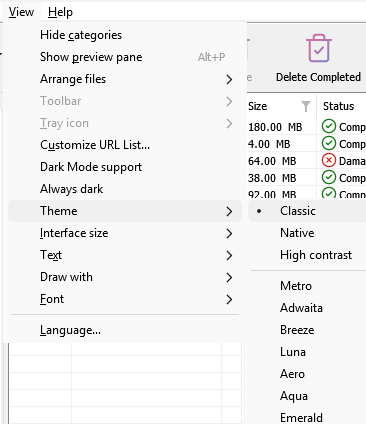
View → Theme changes VDM's look at once, keeping its layout:
- Classic: VDM's own look, the default.
- Nativ: Die Farben Ihres Systems. Die Akzentfarbe von Windows (Einstellungen → Personalisierung → Farben) und, wenn aktiviert, dessen Kontrastdesign; die Akzentfarbe des Desktops und dessen höhere Kontrasteinstellung unter Linux (GNOME 47 und höher, KDE Plasma); die Akzentfarbe unter macOS. VDM folgt diesen, wenn Sie sie ändern.
- Hoher Kontrast: Schwarz und Weiß, ein heller Akzent, jede Kante gezeichnet, Text mit 7:1 oder mehr.
- Metro: Windows 8's flat look: square corners, flat buttons and boxes, a coloured title bar with the title centred (on Windows, where VDM draws it), and one-colour icons (Microsoft's Fluent UI System Icons).
- Adwaita: GNOME's look: round corners, flat grey buttons, a rounded focus ring, GNOME's check boxes, a header bar with the title in bold and round buttons (on Windows, where VDM draws it), and GNOME's Adwaita icons, in colour for files and categories, one colour in the toolbar.
- Breeze: KDE Plasma's look: rounded corners, buttons and boxes that take the accent's edge under the pointer or when focused, KDE's check boxes and focus frame, KDE's title bar with the title centred and round buttons (on Windows, where VDM draws it), and KDE's Breeze icons.
- Luna: Windows XP's look: buttons shaded from white with an orange glow under the pointer, green ticks, square text boxes, progress in green blocks, a deep blue title bar with the title in bold (on Windows, where VDM draws it), and colourful icons drawn for VDM in that manner.
- Aero: Windows 7's look: glossy buttons that turn light blue under the pointer, quiet check boxes, a glossy green progress bar, a glassy title bar with the title on a soft glow (on Windows), and glossy icons drawn for VDM in that manner.
- Aqua: Mac OS X's look: gel buttons round at the ends (the default one blue), glossy check boxes, a blue focus ring, a blue gel progress bar, a grey title bar with small round buttons (on Windows), and icons drawn for VDM in that manner.
- Emerald: eine weiße Oberfläche mit fast schwarzer Schrift und einer Skala neutraler Grautöne für die Struktur, smaragdgrüne Füllungen, die immer fast schwarzen Text statt weißen Text tragen, 6-Punkt-Ecken an jedem Steuerelement und die einfarbigen Symbole von Metro.
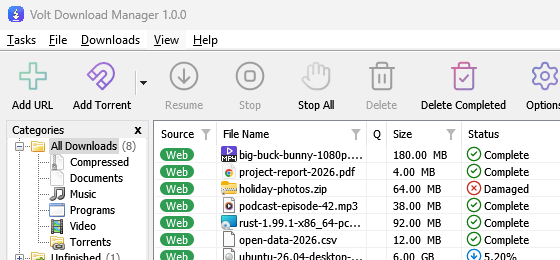
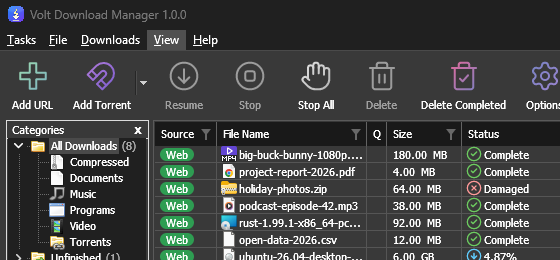
Klassisch 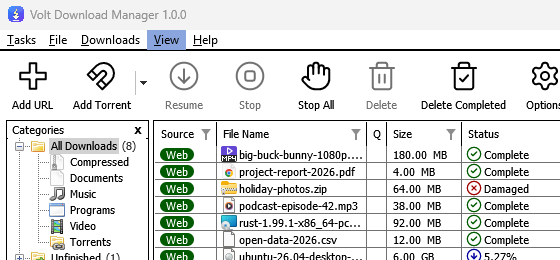
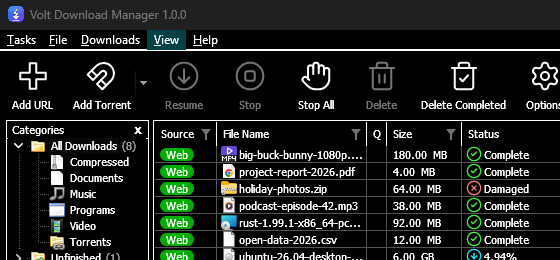
Hoher Kontrast 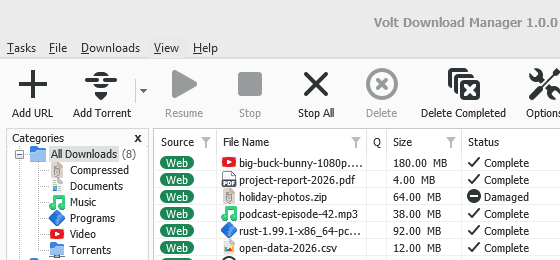
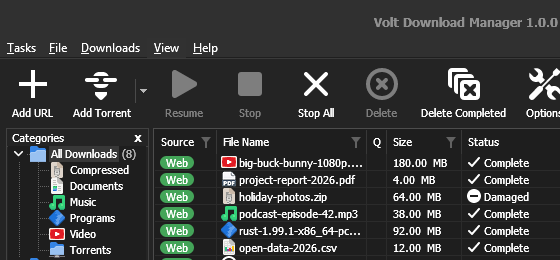
Adwaita 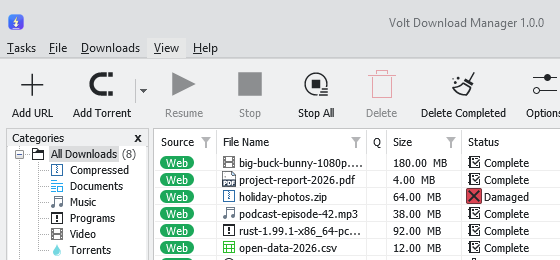
Breeze
Jedes hat eine helle und eine dunkle Seite: Dark Mode-Unterstützung und Immer dunkel wählen wie zuvor zwischen ihnen. Designdateien, die Sie in den Themenordner legen (Ansicht → Design → Themenordner öffnen), werden dort ebenfalls aufgelistet, ebenso wie Base16- und pywal-Farbschemata (Ansicht → Design → Designdatei hinzufügen…; pywal folgt wal, wenn es läuft): Themes beschreibt, wo sich dieser Ordner befindet, was eine Designdatei enthält (inherits, Farben, Größen, Steuerelementformen, Symbole), wie die Farben eines Schemas verwendet werden und wie man eines erstellt und teilt.
Das Taskleistensymbol
Closing the main window doesn't quit VDM. It hides in the notification area, and downloads, queues and schedules carry on. To make closing quit (a portable copy's folder can then be deleted), untick Options → General → Keep running when closing the window. If there is no icon for VDM at all — not in the notification area, nor behind the ^ hidden icons — the window minimizes to the taskbar instead, so downloads continue and there is a way back. An icon behind ^ can be clicked to bring the window back, and starting VDM again always does. On macOS the window closes into the Dock, as Mac apps' windows do: click VDM's icon in the Dock (or in the menu bar) to bring it back, and quit with Cmd+Q or Volt Download Manager → Quit.
On Linux this needs a tray, which most desktops have (KDE Plasma, Xfce, Cinnamon, Ubuntu's GNOME or GNOME with the AppIndicator extension, waybar's tray). On a desktop without one (some tiling window managers), closing the window quits VDM, since there would be nowhere to bring it back from.
- Click the tray icon to see what is downloading: a small panel over the icon lists each running download with its progress bar, how much has come of how much, its speed and the time left, and the progress window's Pause (then Resume; Stop and save for a live stream being recorded) and Cancel beside it. Open Volt Download Manager at its bottom brings the window back. Its ×, Esc, a click elsewhere or another click on the icon closes it.
- Doppelklicken Sie auf das Taskleistensymbol, um das Fenster sofort wieder in den Vordergrund zu bringen (Windows).
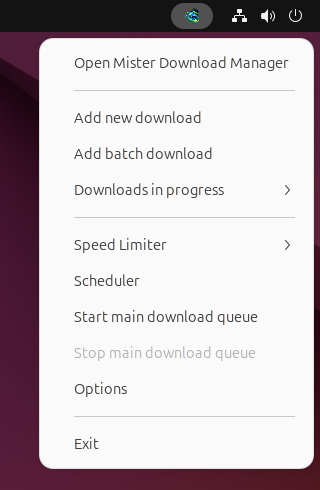
- Klicken Sie mit der rechten Maustaste darauf für Neuen Download hinzufügen, Batch-Download hinzufügen, Aktive Downloads, Geschwindigkeitsbegrenzer, Zeitplaner, die Haupt-Download-Warteschlange, Optionen und Beenden.
- Aktive Downloads listet die laufenden Downloads auf. Wählen Sie einen aus, um dessen Fortschrittsfenster zu sehen.
- Options → General → Show downloads when the notification area icon is clicked is ticked in a new copy of VDM. Untick it and a click on the icon brings the window back (or hides it there while it is in front), as it did before the panel. An VDM that was set up before the panel keeps that click: tick it to have the panel.
- On Linux the panel depends on the desktop's tray. KDE Plasma and Xfce send VDM the click, so the panel opens beside the icon. GNOME's AppIndicator extension may open the icon's menu on a left click instead, or send no place for the click: the panel then opens at the top right of the screen, under GNOME's top bar. In a native Wayland session the compositor decides where the panel goes and may not give it the focus, so a click elsewhere doesn't close it there: use its × or click the icon again. If the panel doesn't suit your desktop, untick the option above.
Minimieren verbirgt das Hauptfenster ebenfalls dort, während In den Infobereich minimieren unter Optionen → Allgemein aktiviert ist. Dies ist standardmäßig der Fall; wenn der Infobereich kein Symbol hat, sendet Minimieren das Fenster stattdessen an die Taskleiste.
Das Fortschrittsfenster eines Downloads kann ebenfalls dorthin verschoben werden, entweder mit der Schaltfläche „Minimieren“ oder mit der Schaltfläche Im Infobereich ausblenden: ein kurzer Strich mit einem Pfeil nach unten in die Ecke.
Unter Windows befindet sich diese Schaltfläche in der Titelleiste des Fensters, links neben „Minimieren“, und im Menü der Titelleiste (Alt+Leertaste). Unter Linux und macOS befindet sie sich am Ende der Registerkartenleiste.
Um das Fenster wiederherzustellen, wählen Sie es unter Aktive Downloads aus oder doppelklicken Sie auf den Download in der Liste.
Zum Beenden wählen Sie Aufgaben → Beenden oder Beenden im Taskleistenmenü.
Where VDM keeps its data
Die Download-Liste und die Einstellungen befinden sich in %APPDATA%\voltdownloadmanager (downloads.json); unter Linux in ~/.local/share/voltdownloadmanager, auf einem Mac in ~/Library/Application Support/voltdownloadmanager. Eine portable Kopie speichert sie stattdessen in ihrem data-Ordner. Heruntergeladene Dateien landen in Ihrem Downloads-Ordner, sortiert in einen Ordner pro Kategorie; dies können Sie unter Optionen → Speichern in ändern.
Nächste Schritte
Kostenlos, Open Source, keine Werbung, keine Testversion.
Download Volt Download Manager