

VDM runs on Windows 10 and Windows 11 (x64, ARM64 and 32-bit), and on 64-bit Linux (x86-64 and ARM64): see On Linux. Builds for macOS are new and still experimental: see On a Mac.
Scegli un download
Tutte le versioni si trovano nella pagina Release. Per Windows ci sono tre file:
| File | Cos'è |
|---|---|
VoltDownloadManager-<version>-setup.exe |
The installer. Pick this one unless you have a reason not to. It can set up browser integration and open .torrent files and magnet links with VDM. |
VoltDownloadManager-<version>-portable.zip |
Una copia portatile. L'elenco dei download e le impostazioni rimangono in una cartella data accanto al programma, e nulla viene scritto nel registro. L'integrazione con i browser richiede il programma di installazione. Vedi Modalità portatile. |
VoltDownloadManager-<version>-x64.zip |
Gli stessi programmi senza un programma di installazione. Mantiene i suoi dati in %APPDATA%\voltdownloadmanager, come una copia installata. |
Questi tre sono per Windows a 64 bit su processore Intel o AMD (x64), il PC più comune. Dalla versione 0.6.0, ognuno è disponibile anche per altri due tipi di PC, con il processore nel nome:
| File | Per |
|---|---|
...-setup-arm64.exe, ...-portable-arm64.zip,...-arm64.zip |
Windows su ARM (PC con processore Snapdragon o altro ARM). Su Windows 11, i file x64 funzionano anche lì, tradotti da Windows, ma più lentamente. L'installazione ARM64 sopra quella x64 la sostituisce; il tuo elenco e le tue impostazioni restano invariati, poiché sono conservati nel tuo profilo, non con il programma. |
...-setup-x86.exe, ...-portable-x86.zip,...-x86.zip |
32-bit Windows 10. Not sure which you have? Settings → System → About → System type says it. VDM can't download ffmpeg for you there (none is built for 32-bit Windows that VDM can check): to get the best video qualities, choose an ffmpeg of your own in Helpers... (Video). |
Guida → Verifica aggiornamenti aggiorna ogni copia ai file per il suo processore.
Con WinGet
VDM is also in WinGet, Windows' package manager. In a terminal, the first line installs VDM and the second updates it to the latest version:
winget install MikaiL.VoltDownloadManager
winget upgrade MikaiL.VoltDownloadManager
WinGet downloads the setup and installs VDM without the setup's questions.
Su Linux
VDM runs on 64-bit Linux with a desktop session. It is tested on Ubuntu 24.04, Debian 12 and
Fedora, with GNOME, KDE Plasma, Xfce and Cinnamon, on X11 and in Wayland sessions. Pick one
of these files (up to version 0.2.4, their names end in -experimental, as in
...-linux-x86_64-experimental.deb). From version 0.6.0, each also comes for 64-bit
ARM computers, with arm64 in place of x86_64 (...-linux-arm64.deb); they are built and
tested on GitHub's ARM machines. On ARM, VDM doesn't download gallery-dl itself (its author
builds none for it): install it with your system's packages or pip.
| File | Cos'è |
|---|---|
...-linux-x86_64.deb |
For Ubuntu, Debian, Mint and Pop!_OS: sudo apt install ./<file>.deb. It brings the libraries VDM needs. |
...-linux-x86_64.rpm |
For Fedora, openSUSE and RHEL: sudo dnf install ./<file>.rpm. It brings the libraries VDM needs. |
...-linux-x86_64.AppImage |
Funziona sulla maggior parte delle distribuzioni: rendilo eseguibile (chmod +x) e avvialo. Si aggiorna automaticamente (Guida → Verifica aggiornamenti). |
...-linux-x86_64.tar.gz |
I programmi senza installazione, per qualsiasi distribuzione. |
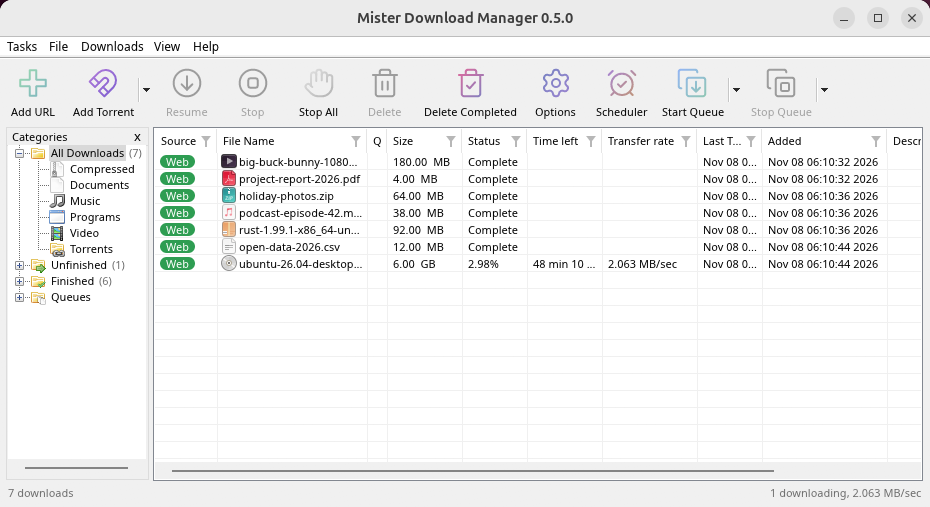
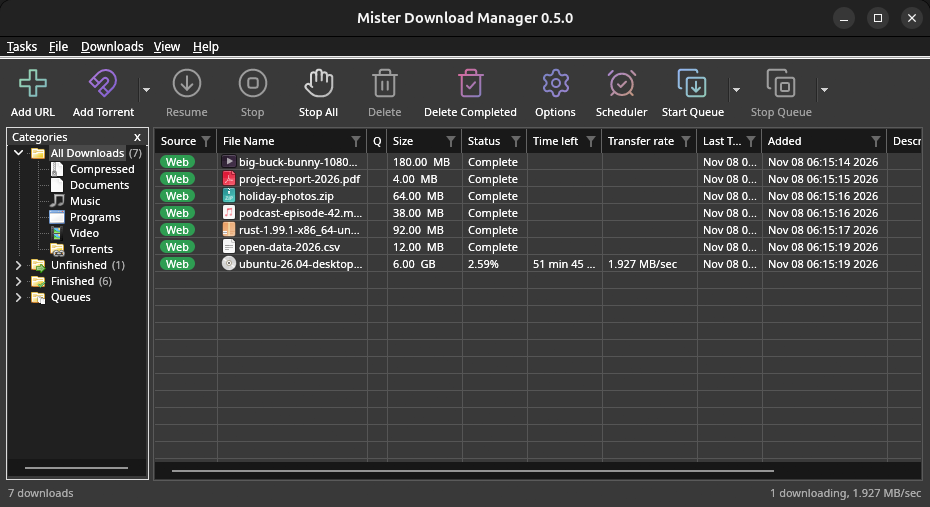
Browser integration is set up by VDM itself at each start (the browsers installed then are found); add the extension as in Browser integration. Firefox installed as a Snap (Ubuntu's) reaches VDM once you allow it; other Snap and Flatpak browsers can't (see Flatpak and Snap browsers). The tray icon, Dark Mode support and Launch on startup work on GNOME (Ubuntu's), KDE Plasma, Xfce and Cinnamon. Running downloads show their progress on VDM's icon in docks that can show it, such as Ubuntu Dock and KDE Plasma's task manager, as on the Windows taskbar (more).
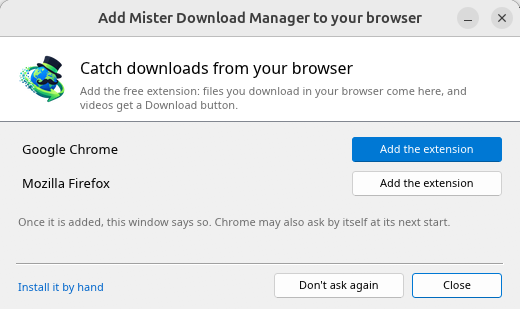
In a Wayland session the windows go through XWayland or Wayland (below). Not there yet on Linux: screen readers (Orca) don't read VDM's windows; browsers installed as a Flatpak can't reach VDM (Firefox from Flathub may, through the desktop as the Snap does, but that isn't checked yet); and View → Draw with → Vulkan is a choice, OpenGL stays the default.
In a Wayland session, VDM chooses its windows' system as it starts, the same way however it was started (its menu entry, the browser's helper, the session's autostart). Its windows run through XWayland where X11 programs look right: only X11 lets VDM open its menus and drop-down lists right under what you clicked (on Wayland they open where the compositor puts new windows, often the middle of the screen) and hide its window in the notification area. That is GNOME and KDE Plasma, which tell X11 programs the screen's scale, and any desktop whose screens aren't scaled. On a scaled screen where nothing tells X11 programs the scale (Hyprland, labwc, sway and other wlroots compositors), the compositor would scale VDM's windows up, blurry, so VDM uses Wayland's own windows there. View → Window system picks X11 (XWayland) or Wayland instead, from the next start, for every way VDM starts (Automatic goes back to VDM's choice); VDM_WAYLAND=1 or VDM_WAYLAND=0 decides for one start. If the system lacks a library X11 windows need (such as libxkbcommon-x11, which the .deb and .rpm bring but the AppImage and the tar.gz can't), VDM opens on Wayland instead; with no window system it can use, it names what's missing and the command that installs it.
Le finestre sono quelle descritte in questa guida, con i font, le icone dei file e le barre del titolo del desktop:
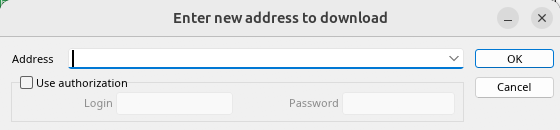
Aggiungi URL. 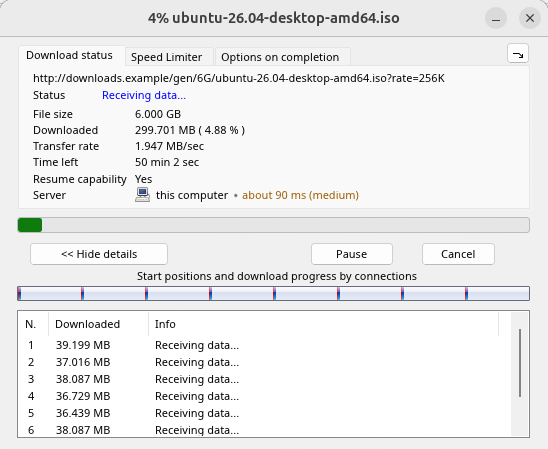
Avanzamento di un download. 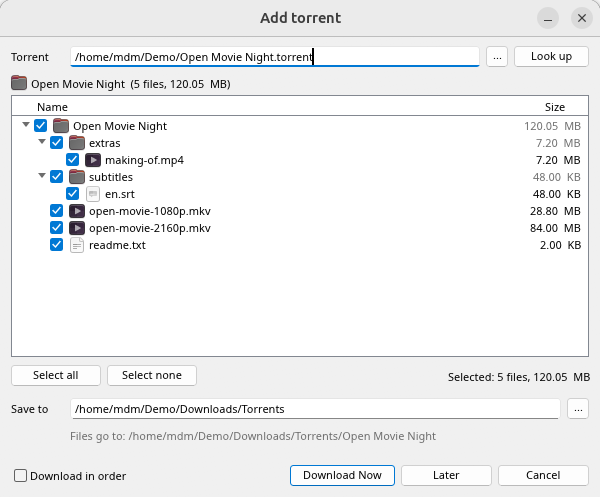
Aggiungi torrent. 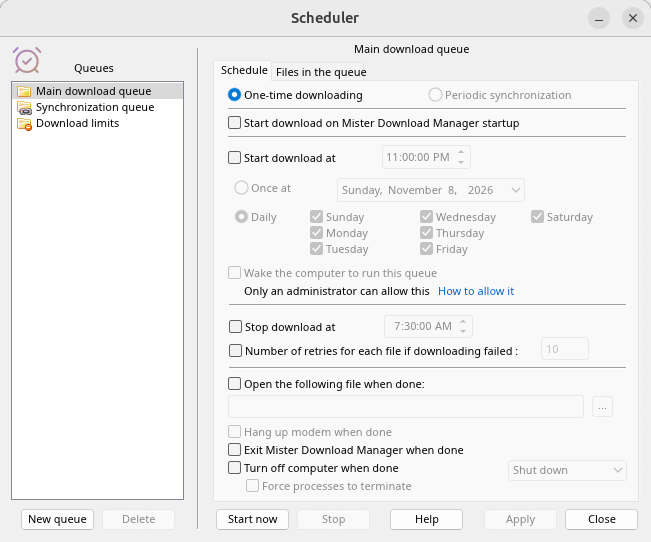
Il Pianificatore. 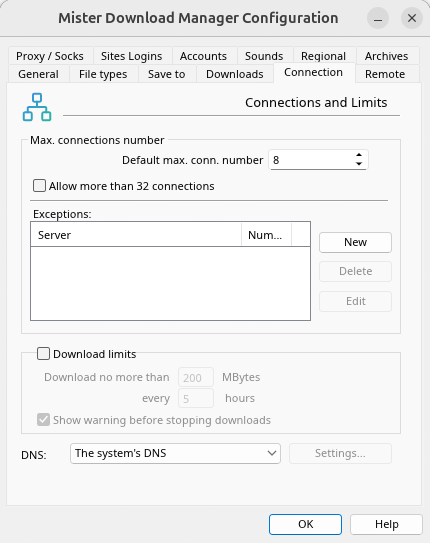
Opzioni.
E sugli altri desktop su cui è stato verificato:
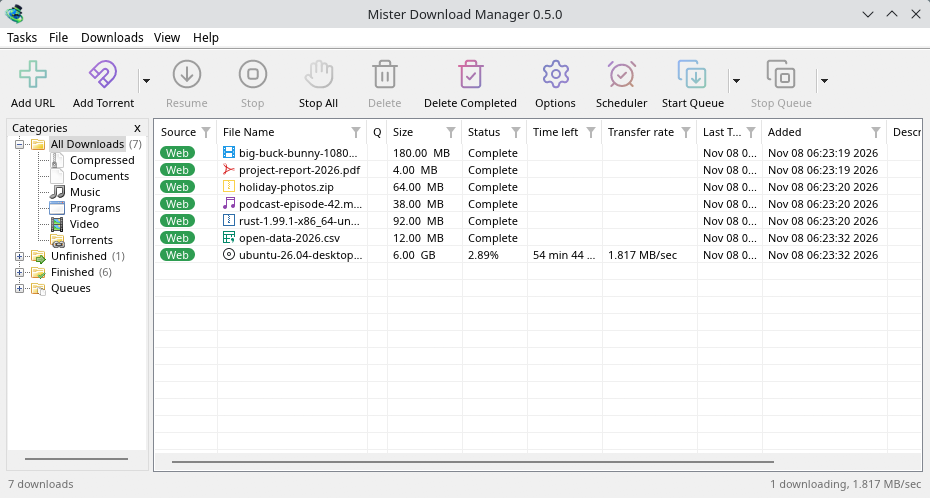
KDE Plasma. 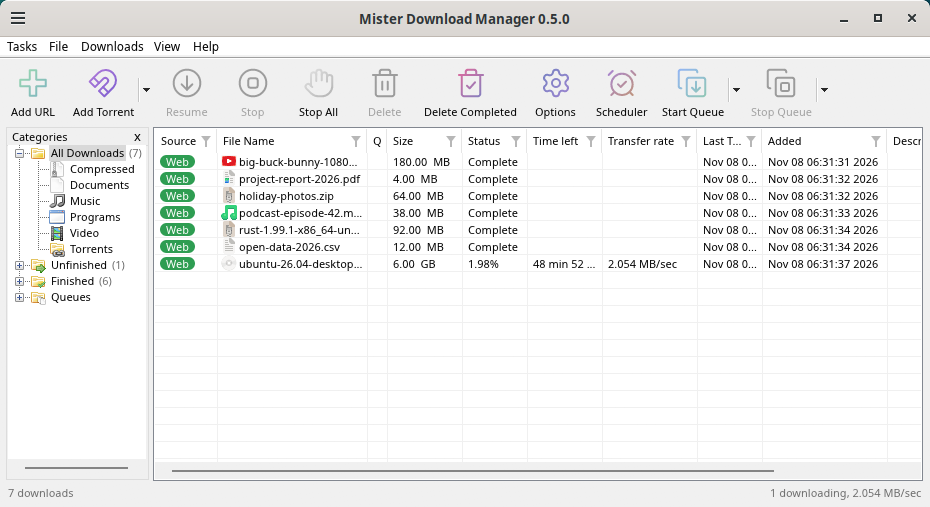
Cinnamon. 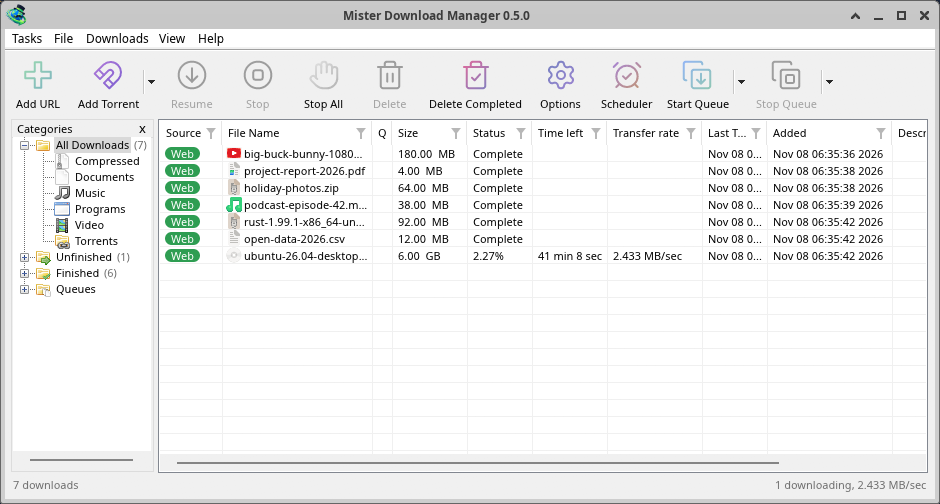
Xfce.
Disinstallazione su Linux
sudo apt remove voltdownloadmanager (or sudo dnf remove voltdownloadmanager) removes the
programs, and the small files that tell your browsers where VDM's helper is: the .deb and .rpm
install those for everyone (in /etc and /usr/lib), for Chrome, Chromium, Edge, Brave, Vivaldi,
Helium and Firefox (the Snap too), so VDM doesn't write them in your home folder. For the AppImage
or the tar.gz, delete the file or the folder.
What VDM keeps in your home folder stays, as with any package: your list and settings
(~/.local/share/voltdownloadmanager), the AppImage's and the tar.gz's browser files, and
those of the browsers that read them only there (Opera, Helium, Thorium, and Firefox's forks:
Zen, LibreWolf, Floorp, Waterfox). A package can't remove those: it never touches
home folders. Without VDM they lead nowhere, so the extension says it can't reach VDM. To remove
them as well, run this as each user who used VDM, before uninstalling:
voltdownloadmanager-nmhost --unregister
(Dall'AppImage: ~/.local/share/voltdownloadmanager/browser-host/voltdownloadmanager-nmhost --unregister.) Già disinstallato? Questo comando rimuove gli stessi file:
find ~/.mozilla ~/.librewolf ~/.config -name com.voltdownloadmanager.host.json -delete 2>/dev/null
Su Mac
Le build per macOS sono nuove e ancora sperimentali: non le abbiamo ancora provate su un Mac, quindi saresti tra i primi. Per favore, dicci come è andata, bene o male.
| File | Cos'è |
|---|---|
...-macos-arm64-experimental.dmg |
For a Mac with Apple Silicon (M1 or later: Apple menu → About This Mac shows a Chip). Open it and drag Volt Download Manager to Applications. macOS asks before its first start, because the app isn't notarized by Apple: right-click it and choose Open (on macOS 15 and later: System Settings → Privacy & Security → Open Anyway). |
...-macos-x86_64-experimental.dmg |
Lo stesso, per un Mac con processore Intel (Informazioni su questo Mac mostra un Processore). |
Browser integration is set up by VDM itself at each start (the browsers installed then are found); add the extension as in Browser integration.
Installa con il programma di installazione
- Esegui
VoltDownloadManager-<version>-setup.exe. - Choose the language. Windows' display language is already selected. The setup offers every language VDM has, and VDM starts in the one you pick.
- Scegli se installare VDM solo per te o per tutti gli utenti del computer. Per installarlo solo per te non servono i diritti di amministratore e verrà installato in
%LOCALAPPDATA%\Programs\Volt Download Manager. Per tutti gli utenti verrà installato inProgram Files. - Pick what the setup should do: - Set up browser integration (Chrome, Edge, Brave, Firefox) - Open .torrent files and magnet links with Volt Download Manager - Start Volt Download Manager when Windows starts - Create a desktop shortcut (off unless you tick it)
- Click Install, then Finish to start VDM.
If VDM is already running, the setup asks it to save and close first. To update, use Help → Check for updates → Update now, or run the setup of the new version (or update with WinGet); your list and settings stay.
L'integrazione con i browser richiede un passaggio aggiuntivo per ogni browser: l'aggiunta dell'estensione. In Firefox, fai clic su Aggiungi a Firefox sulla sua pagina su addons.mozilla.org; in Chrome, Edge, Brave, Opera e Vivaldi, Aggiungi a Chrome sulla sua pagina nel Chrome Web Store. La sezione Integrazione con i browser mostra come fare.
Disinstalla
Uninstall VDM from Windows Settings → Apps. The uninstaller asks whether to delete your download list and settings too. Your downloaded files are never touched.
Usa una copia zip
- Decomprimi il file in una cartella in cui puoi scrivere (non direttamente in
Program Files). - Esegui
voltdownloadmanager.exe.
Gli archivi ZIP contengono gli stessi programmi del programma di installazione: l'app, voltdownloadmanager-cli.exe (per scaricare dalla riga di comando; vedi Riga di comando e automazione) e la cartella extension.
Primo avvio e lingua
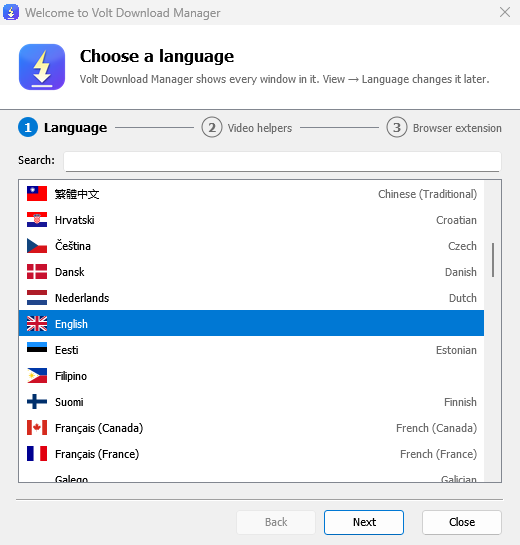
On its first start VDM opens one Welcome to Volt Download Manager window that walks you through what it needs, a step at a time: the steps are named on top, Back and Next move between them, and Finish on the last one closes it. Each step can be passed with Next without doing anything, Close or the window's × ends the setup at any step, and once it is finished or closed it doesn't come back: everything in it stays in the menus. Steps that aren't needed are left out.
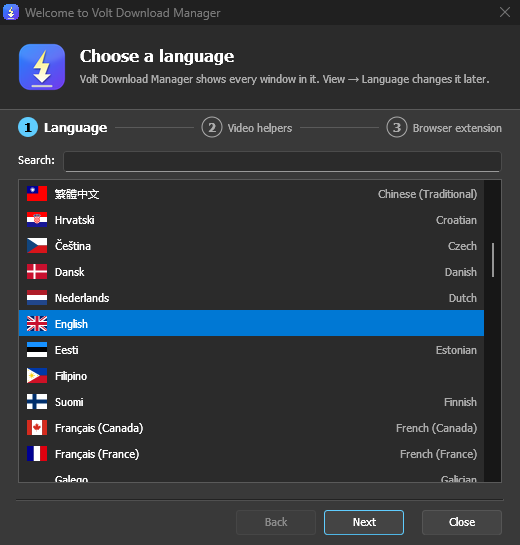
- Language. - Installed with the setup: VDM starts in the language you chose in the setup, and this step is left out. - Otherwise: the list of languages, each with its flag and its own name. Click yours: the window switches to it at once, right to left for Arabic, Hebrew, Persian and Urdu.
Puoi cambiarla in qualsiasi momento in Visualizza → Lingua. Maggiori informazioni in Lingue.
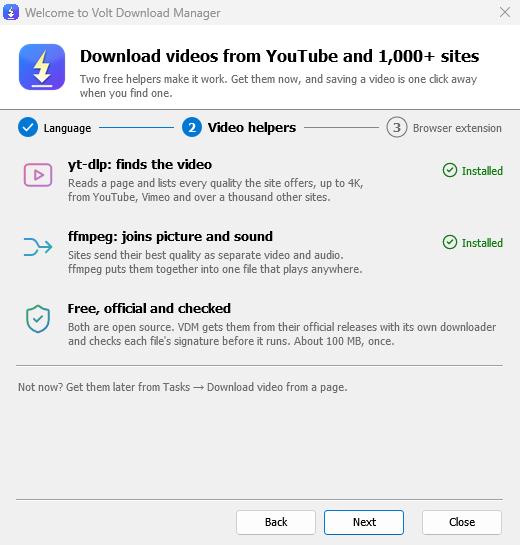
- Programmi di supporto per i video (sotto).
- Browser extension: each browser VDM found, with Add the extension for it, as in Browser integration. Left out when a browser's extension already reached VDM, or in a portable copy.
I programmi di supporto per i video
The setup's second step offers VDM's free video helpers: yt-dlp, which finds the video on a page, ffmpeg, which joins its picture and sound (on Windows; elsewhere VDM uses your system's), and Node.js, which YouTube needs, when your computer has no JavaScript runtime. Each says whether it is already there; one that isn't has its own Install button, and Yes, download them (recommended) gets every one that is missing. They download in the background, about 100 MB, once, each with its progress in its row, and go on if you close the window. Nothing is downloaded until you press one. Next leaves them for later: the video window offers them when you first need them. The step is left out when they are all there. More in Videos.
La finestra principale
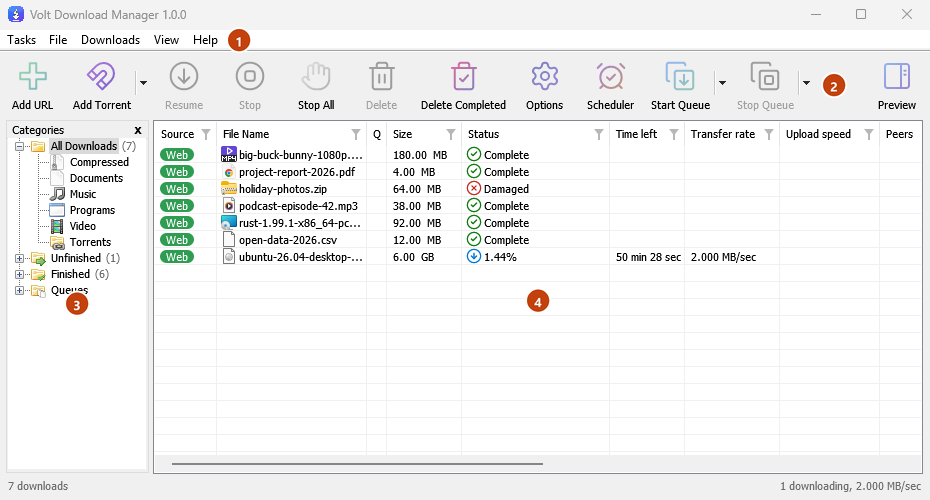
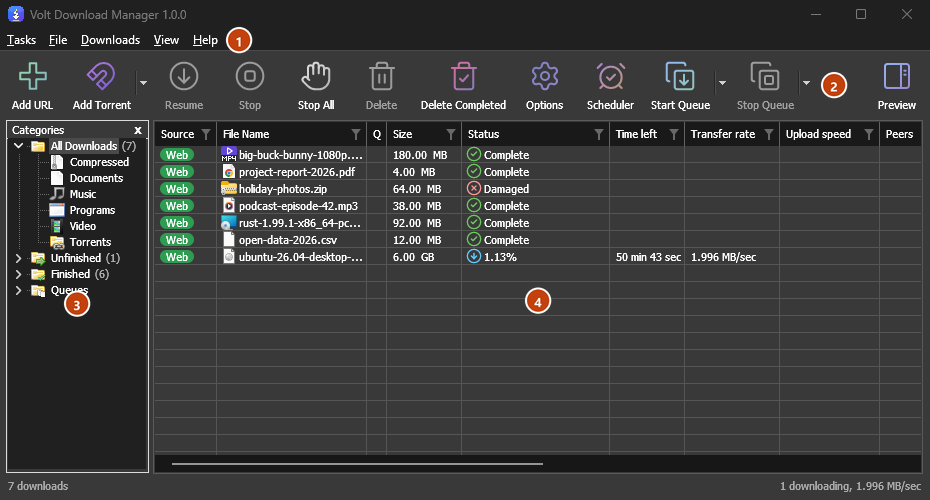
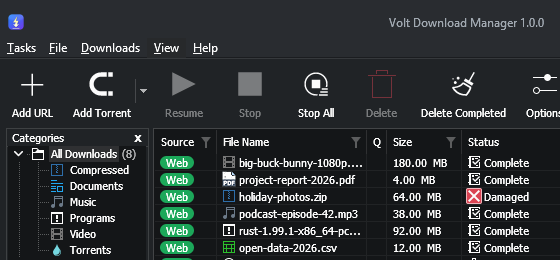
Dall'alto in basso:
- Barra dei menu.
- Attività: aggiungi download, torrent, link magnet, download in batch e video da una pagina; Impostazioni torrent; Link grabber; Feed RSS; mostra l'area di rilascio; importa ed esporta l'elenco; esci.
- File: il download selezionato: Interrompi download, Rimuovi, Scarica ora, Scarica di nuovo.
- Download: Metti tutto in pausa, Interrompi tutto, Elimina tutti i completati, Trova, il Pianificatore, le code, il Limitatore di velocità e le Opzioni.
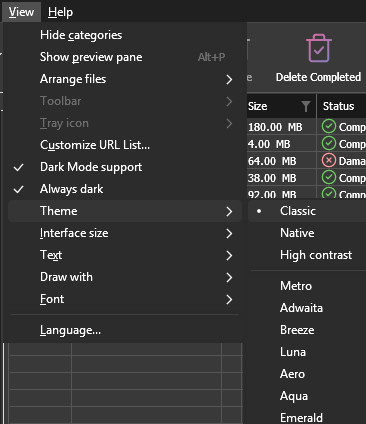
- Visualizza — mostra o nasconde le categorie, ordina l'elenco (Ordina file), Supporto modalità scura, Sempre scuro, Tema, Dimensioni interfaccia (ogni finestra più grande, dal 100% al 200%; anche Ctrl +, Ctrl − e Ctrl 0), Font (il file del font e la dimensione del testo dell'interfaccia, a parte Dimensioni interfaccia), Testo (Windows: lettere lisce o classiche), Rendering con (OpenGL, o Direct3D su Windows, Vulkan su Linux, Metal su macOS) e Lingua.
- Help — help pages and tutorials (on the website, in your language when it has it), Keyboard shortcuts, Report a problem, Check for updates, About, Tell a friend and Support VDM (its creator's GitHub Sponsors page: optional, nothing in VDM changes).
- Barra degli strumenti. Aggiungi URL, Aggiungi torrent, Riprendi, Interrompi, Interrompi tutto, Elimina, Elimina completati, Opzioni, Pianificatore, Avvia coda, Interrompi coda. La piccola freccia accanto a Aggiungi torrent, Avvia coda e Interrompi coda apre altre opzioni.
- Categorie (a sinistra). Scegli cosa mostra l'elenco: Tutti i download, Non completati, Completati e Code, ciascuno con le proprie categorie. Trascina il bordo tra il pannello e l'elenco per allargarlo.
- Elenco dei download (a destra). Una riga per ogni download. Vedi L'elenco dei download.
Modalità scura
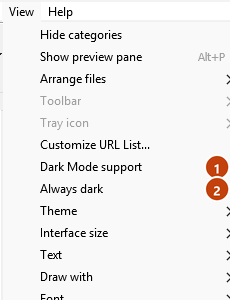
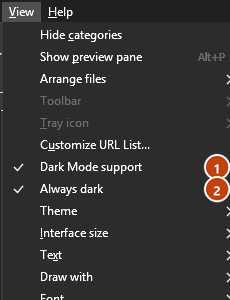
VDM follows your system: when Windows (or your desktop's light/dark preference on Linux and macOS) is set to dark mode, so is VDM. To keep VDM light whatever the system does, turn off View → Dark Mode support. To keep it dark whatever the system does, for example on a desktop that reports no preference, turn on View → Always dark.
Temi
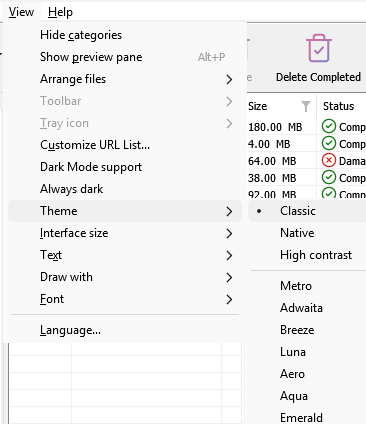
View → Theme changes VDM's look at once, keeping its layout:
- Classic: VDM's own look, the default.
- Nativo: i colori del sistema. Il colore principale di Windows (Impostazioni → Personalizzazione → Colori) e, se attivo, il tema a contrasto; il colore principale del desktop e l'impostazione di contrasto elevato su Linux (GNOME 47 e versioni successive, KDE Plasma); il colore principale su macOS. VDM segue le modifiche che apporti a queste impostazioni.
- Contrasto elevato: bianco e nero, un colore principale acceso, tutti i bordi visibili, testo con contrasto di almeno 7:1.
- Metro: Windows 8's flat look: square corners, flat buttons and boxes, a coloured title bar with the title centred (on Windows, where VDM draws it), and one-colour icons (Microsoft's Fluent UI System Icons).
- Adwaita: GNOME's look: round corners, flat grey buttons, a rounded focus ring, GNOME's check boxes, a header bar with the title in bold and round buttons (on Windows, where VDM draws it), and GNOME's Adwaita icons, in colour for files and categories, one colour in the toolbar.
- Breeze: KDE Plasma's look: rounded corners, buttons and boxes that take the accent's edge under the pointer or when focused, KDE's check boxes and focus frame, KDE's title bar with the title centred and round buttons (on Windows, where VDM draws it), and KDE's Breeze icons.
- Luna: Windows XP's look: buttons shaded from white with an orange glow under the pointer, green ticks, square text boxes, progress in green blocks, a deep blue title bar with the title in bold (on Windows, where VDM draws it), and colourful icons drawn for VDM in that manner.
- Aero: Windows 7's look: glossy buttons that turn light blue under the pointer, quiet check boxes, a glossy green progress bar, a glassy title bar with the title on a soft glow (on Windows), and glossy icons drawn for VDM in that manner.
- Aqua: Mac OS X's look: gel buttons round at the ends (the default one blue), glossy check boxes, a blue focus ring, a blue gel progress bar, a grey title bar with small round buttons (on Windows), and icons drawn for VDM in that manner.
- Smeraldo: una tela bianca con un inchiostro quasi nero e una scala di grigi neutri per la struttura, riempimenti color smeraldo che portano sempre testo quasi nero anziché bianco, angoli a 6 punti su ogni controllo e le icone monocromatiche di Metro.
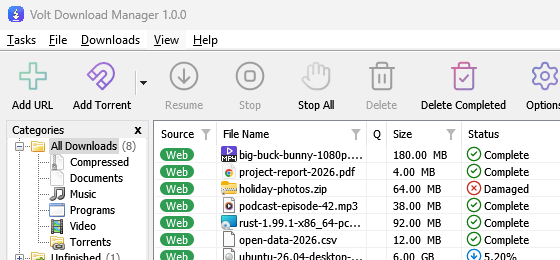
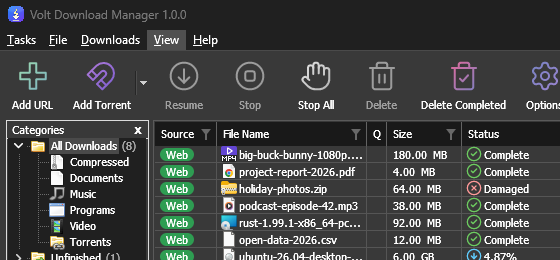
Classico 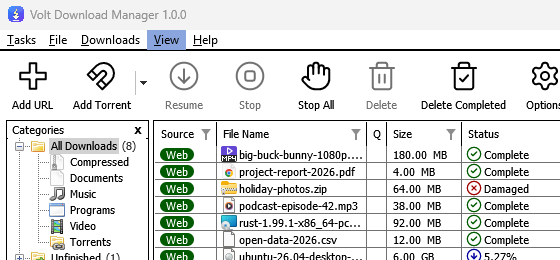
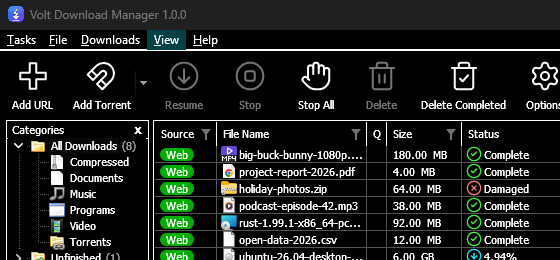
Contrasto elevato 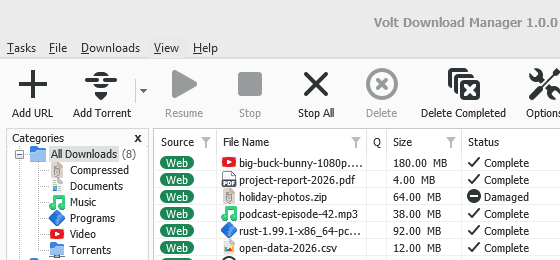
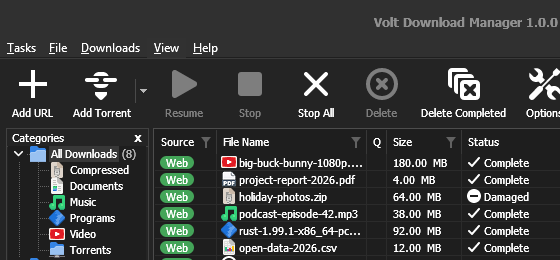
Adwaita 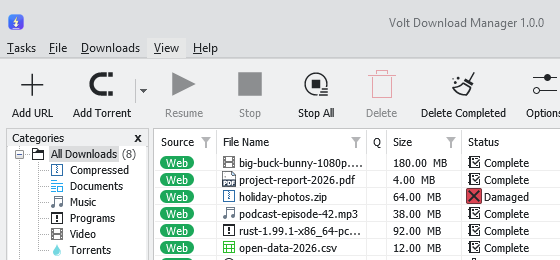
Breeze
Ognuno ha un lato chiaro e uno scuro: il Supporto modalità scura e Sempre scuro permettono di scegliere tra i due come prima. I file di tema che metti nella cartella dei temi (Visualizza → Tema → Apri la cartella dei temi) sono elencati anche lì, così come gli schemi di colore Base16 e pywal (Visualizza → Tema → Aggiungi un file di tema…; pywal segue wal mentre è in esecuzione): Temi spiega dove si trova quella cartella, cosa contiene un file di tema (inherits, colori, dimensioni, forme dei controlli, icone), come vengono usati i colori di uno schema e come crearne e condividerne uno.
L'icona nell'area di notifica
Closing the main window doesn't quit VDM. It hides in the notification area, and downloads, queues and schedules carry on. To make closing quit (a portable copy's folder can then be deleted), untick Options → General → Keep running when closing the window. If there is no icon for VDM at all — not in the notification area, nor behind the ^ hidden icons — the window minimizes to the taskbar instead, so downloads continue and there is a way back. An icon behind ^ can be clicked to bring the window back, and starting VDM again always does. On macOS the window closes into the Dock, as Mac apps' windows do: click VDM's icon in the Dock (or in the menu bar) to bring it back, and quit with Cmd+Q or Volt Download Manager → Quit.
On Linux this needs a tray, which most desktops have (KDE Plasma, Xfce, Cinnamon, Ubuntu's GNOME or GNOME with the AppIndicator extension, waybar's tray). On a desktop without one (some tiling window managers), closing the window quits VDM, since there would be nowhere to bring it back from.
- Click the tray icon to see what is downloading: a small panel over the icon lists each running download with its progress bar, how much has come of how much, its speed and the time left, and the progress window's Pause (then Resume; Stop and save for a live stream being recorded) and Cancel beside it. Open Volt Download Manager at its bottom brings the window back. Its ×, Esc, a click elsewhere or another click on the icon closes it.
- Fai doppio clic sull'icona della barra delle applicazioni per riportare subito in primo piano la finestra (Windows).
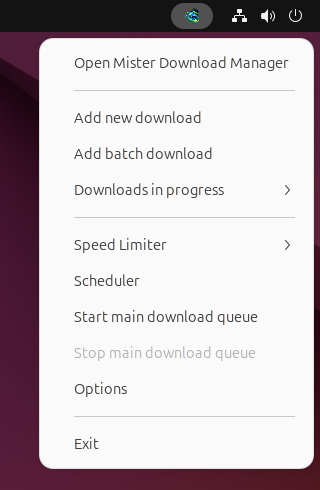
- Fai clic destro sull'icona per Aggiungi nuovo download, Aggiungi download in batch, Download in corso, Limitatore di velocità, Pianificatore, la coda di download principale, Opzioni ed Esci.
- Download in corso elenca i download attivi. Scegline uno per vedere la sua finestra di avanzamento.
- Options → General → Show downloads when the notification area icon is clicked is ticked in a new copy of VDM. Untick it and a click on the icon brings the window back (or hides it there while it is in front), as it did before the panel. An VDM that was set up before the panel keeps that click: tick it to have the panel.
- On Linux the panel depends on the desktop's tray. KDE Plasma and Xfce send VDM the click, so the panel opens beside the icon. GNOME's AppIndicator extension may open the icon's menu on a left click instead, or send no place for the click: the panel then opens at the top right of the screen, under GNOME's top bar. In a native Wayland session the compositor decides where the panel goes and may not give it the focus, so a click elsewhere doesn't close it there: use its × or click the icon again. If the panel doesn't suit your desktop, untick the option above.
Anche Riduci a icona nasconde la finestra principale, se Riduci a icona nell'area di notifica è attiva in Opzioni → Generale. È attiva per impostazione predefinita; dove l'area di notifica non ha un'icona, Riduci a icona invia la finestra alla barra delle applicazioni.
La finestra di avanzamento di un download può anche andare lì, con il suo pulsante Riduci a icona o con il suo pulsante Nascondi nell'area di notifica: un trattino corto con una freccia verso l'angolo.
Su Windows, quel pulsante si trova nella barra del titolo della finestra, a sinistra di Riduci a icona, e nel menu della barra del titolo (Alt+Spazio). Su Linux e macOS si trova alla fine della riga delle schede.
Per riportare la finestra, sceglila in Download in corso, oppure fai doppio clic sul download nell'elenco.
Per uscire, scegli Attività → Esci o Esci nel menu dell'icona nell'area di notifica.
Where VDM keeps its data
L'elenco dei download e le impostazioni si trovano in %APPDATA%\voltdownloadmanager (downloads.json); su Linux in ~/.local/share/voltdownloadmanager, su Mac in ~/Library/Application Support/voltdownloadmanager. Una copia portatile li conserva invece nella sua cartella data. I file scaricati vanno nella tua cartella Download, ordinati in una cartella per categoria; puoi cambiarlo in Opzioni → Salva in.
Passi successivi
Gratuito, open source, senza pubblicità, senza periodo di prova.
Download Volt Download Manager