

There are several ways to give VDM something to download. Most of them end in the same window, Download File Info, where you choose where the file goes.
Add URL
- Copy the file's address (in a browser: right-click the link → Copy link).
- Click Add URL on the toolbar, choose Tasks → Add new download, or press Ctrl+N.
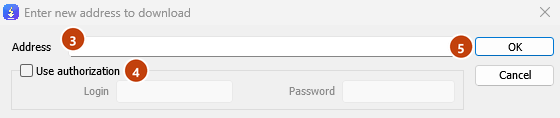
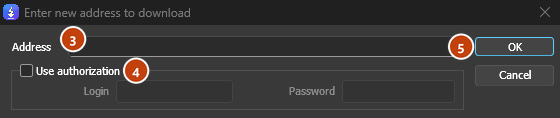
- Enter new address to download opens. If the clipboard holds a web address, it is already filled in. The arrow at the end of Address lists the last 20 addresses you entered; pick one to use it again. Right-click the box for Cut, Copy, Paste, Delete and Select all.
- If the server needs a user name and password, tick Use authorization and type them.
- Click OK.
VDM takes http://, https://, ftp://, ftps://, ftpes:// and magnet: addresses. Anything else gets Invalid address.
A thunder://, flashget:// or qqdl:// link is one of those addresses wrapped in base64, as download pages made for Thunder (Xunlei), FlashGet and QQ's downloader write them. VDM unwraps it and downloads from the address inside, here, from the clipboard and in Link grabber; the download is listed under that address. A link that wraps anything else, or that can't be read, gets Invalid address too.
If the address is a video's page (YouTube, Vimeo, TikTok and others), the video window opens instead. See Video downloads. A magnet link opens Add torrent; see Torrents.
FTP and FTPS
FTP downloads work like web downloads: several connections at once, pause and resume, and the same progress window.
ftp://— plain FTP.ftpes://— FTP secured with TLS from the start of the session (explicit FTPS,AUTH TLS, usually port 21). Use it when the server says it supports TLS.ftps://— implicit FTPS, port 990 unless the address gives another.
The server's certificate is checked against Windows' (or the system's) trusted certificates, as
for https://, and against Mozilla's, the ones Firefox carries, where the system lacks the root
a server's certificate comes from (an older Windows that hasn't fetched it yet). A Linux system without them (a minimal install without the ca-certificates
package) still downloads over plain HTTP and FTP; each secure download then fails at once, saying
to install that package.
An https:// site whose certificate is refused (expired, self-signed or from an issuer the system doesn't
trust, made for another site name) isn't downloaded from: Download File Info, the progress window
and the list say which of these it is, as a browser warns about the same site. VDM has no way
around it.
Logging in. Write the login in the address (ftp://user:password@server/folder/file.iso),
tick Use authorization, or save it in Options → Sites Logins. Without one, VDM logs in as
anonymous. The path is relative to the folder the login starts in; to start from the server's
root, write %2F after the server (ftp://server/%2Fpub/file.iso).
Resuming. VDM keeps the file's size and modification time. If either has changed when you resume, it says the file changed on the server instead of mixing two versions (Options → Downloads → Ignore file modification time changes skips the time check). The password is not written to the resume file next to the download: VDM gives it again when it resumes.
Connections. Passive mode is used by default. Options → Proxy / Socks → Use FTP in PASV
mode switches it off for servers that only take active connections. FTP goes through a SOCKS
proxy set in Options → Proxy / Socks (passive then, always; ftps:// can't go through one
yet), and connects to the server directly when the proxy is an HTTP one.
Browsers no longer download ftp:// links themselves. Right-click one and choose Download with
Volt Download Manager, or copy it and use Add URL.
Google Drive links
Paste a Google Drive link as it is, the one Share → Copy link gives:
https://drive.google.com/file/d/…/view?usp=sharing, with or without/view;https://drive.google.com/uc?id=…&export=downloadandhttps://drive.google.com/open?id=…;https://docs.google.com/document/d/…/edit(and Sheets, Slides, Drawings).
VDM downloads the file itself, as it was uploaded (a video comes in its own format, not the player's copy), with its real name and size, over several connections, and it can resume. For a large file, Drive shows a page that says it can't scan this file for viruses; VDM goes past it as Download anyway does.
Google Docs, Sheets and Slides come as Word (.docx), Excel (.xlsx) and PowerPoint
(.pptx) files, and Drawings as .png. These files are made when they are asked for, so their
size is unknown until they arrive and they can't be resumed: a cut-off download starts again.
Files that aren't shared with everyone. Right-click the link in the browser and choose Download with Volt Download Manager, or use Drive's own Download button: the extension passes your browser's Google sign-in with the download. VDM never asks for or keeps your password. Without a sign-in, VDM says the file needs you to sign in.
When Drive won't give a file. Drive limits how often a file can be downloaded: after many downloads in a day it answers "too many users have viewed or downloaded this file recently". VDM shows Drive's own words and writes nothing. Try again later (it can take up to a day), or sign in to Google in your browser and download from there, which often gets past the limit. VDM doesn't try to get around it. A file whose owner turned off downloading, or that your account can't open, gets no access.
The video button over a Drive video downloads the original file, not one of the player's smaller copies.
Folders: paste a shared folder's link (https://drive.google.com/drive/folders/…) in Add
URL, or right-click it in the browser and choose Download with Volt Download Manager, and
Link grabber lists its files and its subfolders' to download into the same folders. See
Google Drive folders.
Download File Info
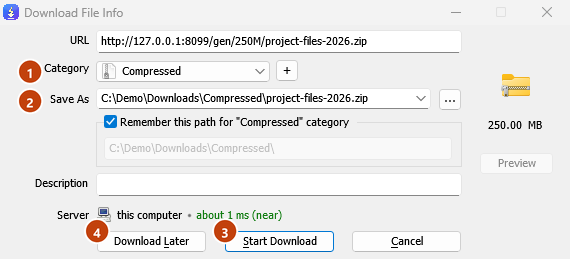
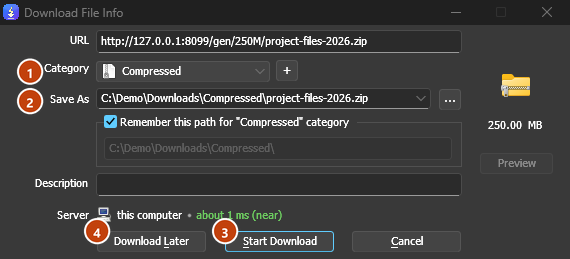
VDM asks the server for the file's name and size, and shows them in Download File Info:
- URL — the address.
- Category — chosen from the file's type (Compressed, Documents, Music, Programs, Video or General). Each category has its own folder. + beside it makes a new category.
- Save As — the folder and file name. You can type another, pick one of the last 20 folders you saved to from the arrow at its end, or choose the folder and the file name in the system's Save dialog with ... (a name typed there without an extension keeps the download's). If you choose a file that is already there and answer Yes when the dialog asks whether to replace it, the download replaces it once it is complete; until then the old file stays as it was, so it is kept if the download fails or you cancel it. A name of a file that is already there that you type in Save As itself is asked about as you press Start Download or Download Later: Add the duplicate with a numbered file name takes the next free name, such as
name (1).zip; Add the duplicate and overwrite the existing file replaces it once the download is complete, as above; Cancel goes back to the dialog. A name VDM gave that is taken by the time the download starts is numbered without asking. - Remember this path for "…" category — tick it to make the folder you typed the category's folder from now on. With Save every download in "General" category's folder ticked in Options → Save to, every download starts in General's folder, and this box names General: the folder you typed becomes the one for every download.
- Description — a note of your own. It shows in the list's Description column and Find can search it.
- Server — where the server is: its country's flag and name, and how long a round trip to it takes. See Where the server is. It stays blank when the browser handed the download over with its name and size, since VDM didn't need to ask the server.
Then choose:
- Start Download (or Enter) — download now. The progress window opens.
- Download Later — add it to a queue without starting. See below.
- Cancel (or Esc) — add nothing.
By default VDM starts downloading while this window is open, so no time is lost while you decide. Cancel drops what it fetched. You can turn this off in Options → Downloads → Start downloading immediately while displaying "Download File Info" dialog.
If the folder doesn't exist yet, VDM asks Do you want to create it? before it starts.
Only some files from inside a ZIP
For a .zip on a web server, Preview (under the file's size) lists what is inside, so you can download only the files you need instead of the whole archive: two files out of a 20 GB archive take two small downloads.
As the window opens, VDM asks the server for the archive's last bytes, where a ZIP keeps its list of files. Only a server that sends parts of a file can give files one by one, so Preview works only there; elsewhere it stays grey, and its tooltip says why (the server can't send parts of the ZIP...). The whole archive still downloads as usual.
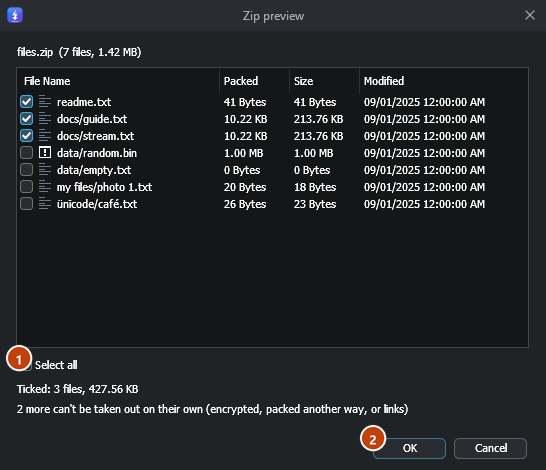
Preview opens Zip preview: every file in the archive with its File Name (its path inside the ZIP), Packed (its size inside the ZIP), Size and Modified. Tick the ones you want (Select all ticks every one) and click OK. The number of files picked shows under Preview; hover over it to see where they go. Then Start Download or Download Later adds them as one download, in place of the archive:
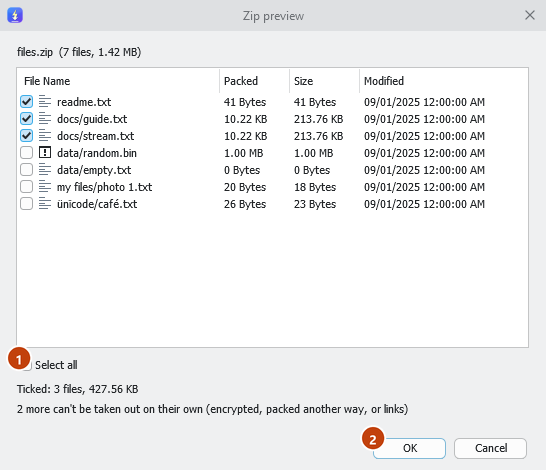
- They go into a folder named after the archive, in the folder Save As shows (
Downloads\Compressed\photos\forphotos.zip), each keeping its path from inside the ZIP (photos\2025\beach.jpg). A file of the same name already there is kept, and the new one numbered. - VDM fetches only each file's own bytes, unpacks it, and checks it against the checksum (CRC-32) and size the archive gives for it. A file that doesn't match is not kept, and the download says so.
- A stopped download goes on with the files not fetched yet; one stopped part-way is fetched again.
- Delete with Also delete the files from disk leaves the folder and its files, as for an image gallery.
Some files can't be taken out on their own and aren't listed (the window counts them under the list): encrypted files, files packed with a method other than the two most ZIPs use (stored and Deflate), links, and names that would put a file outside its folder (../, a drive letter, an absolute path). A ZIP split over several files, or one whose list of files doesn't add up (files over each other, a list larger than VDM reads from a server), can't be previewed. For any of these, download the whole archive.
Each link opens a Download File Info of its own, so several can be open side by side, to compare their sizes before you choose. Each new one opens a little below and beside the one before and comes to the front; from the second on, its title carries its number: Download File Info (2), (3) and so on. Esc closes only the window you're in. Up to six are open at once: more links handed over together (a browser passing on several downloads) wait, and open one by one as you close windows; Cancel asks whether to cancel the ones still waiting. The same link handed over again brings its open window to the front. If you quit VDM with some still open, their downloads go to the Main download queue, as with Download Later.
Download Later
Download Later puts the download in a queue instead of starting it. By default VDM asks which one: pick the queue under Add to queue, and tick Start the queue now if you want it to run straight away. Cancel leaves the download in the list, in no queue.
To skip that question and always use the Main download queue, turn off Options → Downloads → Show queue selection panel on pressing "Download Later" button.
More about queues in Queues and the Scheduler.
From the clipboard
With Options → General → Offer to download links copied to the clipboard ticked (it is, unless you turned it off), when you copy a link to a file type in Options → File types (ZIP, EXE, MP4, PDF and many more), Download File Info opens with it filled in, ready for Start Download. Links to other pages are left alone. With Options → Downloads → Show start download dialog off, the download starts at once instead. Only links copied while VDM runs are taken, never one that was already there.
Copied several links at once, a list or a whole forum post? Choose Tasks → Add batch download from clipboard (Ctrl+B, also in the tray icon's menu). VDM reads the clipboard then, and only then, and finds every download link in the text: http, https, ftp and magnet links, one per line or among other words, in Markdown ([name](https://github.com/mikailhossenimran/voltdownloadmanager/blob/main/docs/link)) or between < and >. Each one is listed once in Link grabber, ticked and sorted into packages: pick a folder for each package, then Start or Add to queue. Downloads added together end with one Downloads complete summary. Magnet links are added as torrents with all their files once their files are known. thunder://, flashget:// and qqdl:// links count as the address wrapped in them, here and for a single copied link. A copied address with a number in its name, such as https://example.com/show/ep01.mp4, opens Batch download instead (below). If the clipboard holds no text, or no link, VDM says so.
Drag and drop
- Choose Tasks → Show drop target. A small box with the VDM icon appears and stays on top of other windows.
- Drag a link from your browser onto it. VDM adds it as if you had used Add URL.
You can also drop magnet links and .torrent files on it. Drag the box to move it, and double-click it to bring the main window back. Right-click it for Show Volt Download Manager, Add new download and Hide drop target.
Batch download: many numbered files
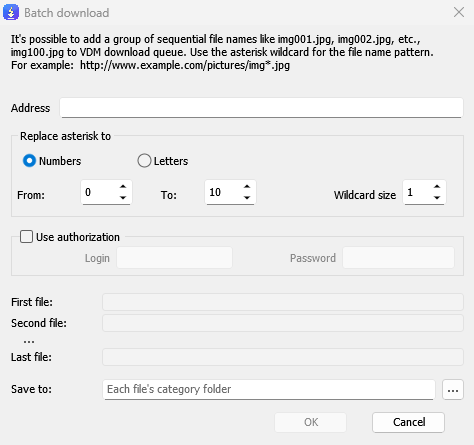
For files whose names differ only by a number or a letter, such as photo001.jpg to photo150.jpg:
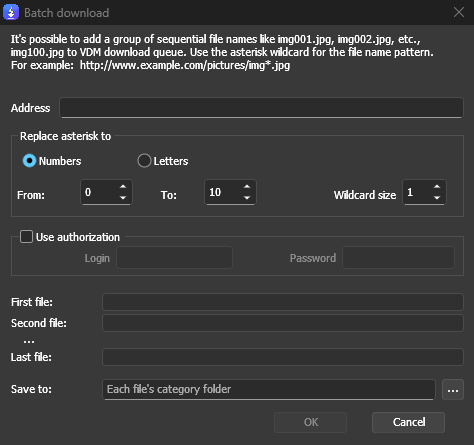
- Choose Tasks → Add batch download. Copied one address with a number in its file name, such as
https://example.com/show/ep01.mp4? Tasks → Add batch download from clipboard (Ctrl+B) puts the asterisk where the number was, sets From and Wildcard size from it (ep*.mp4, from 1, size 2) and waits in To for the last number. - In Address, write the address with one asterisk where the number or letter changes:
https://example.com/photo*.jpg. - Under Replace asterisk to, choose Numbers or Letters, then From and To.
- For numbers, set Wildcard size to the number of digits. With 3, the files are
photo001.jpg,photo002.jpgand so on. - If the server needs a login, tick Use authorization.
- Check First file, Second file and Last file.
- Left empty, Save to puts each file in its category's folder (Options → Save to), or in General's folder when every download goes to one folder there. To put every file of the batch in one folder, type it there or choose it with .... Then click OK.
The downloads go to a queue. As with Download Later, VDM asks which queue unless you turn off Options → Downloads → Show queue selection panel on closing batch download dialogs.
A list of links
To add every link in a text file:
- Choose Tasks → Import → From text file.
- Pick the file. Link grabber lists every web address VDM found in it, in packages. While VDM reads a long file, the strip under the list of downloads says Reading and the file's name; you can go on using VDM meanwhile. Import reads files of up to 64 MB, far more than any list of links holds: a larger file (a video, an archive, a backup picked by mistake) is refused with a message.
- Untick the addresses you don't want (Check all and Uncheck all help), then click Add to queue.
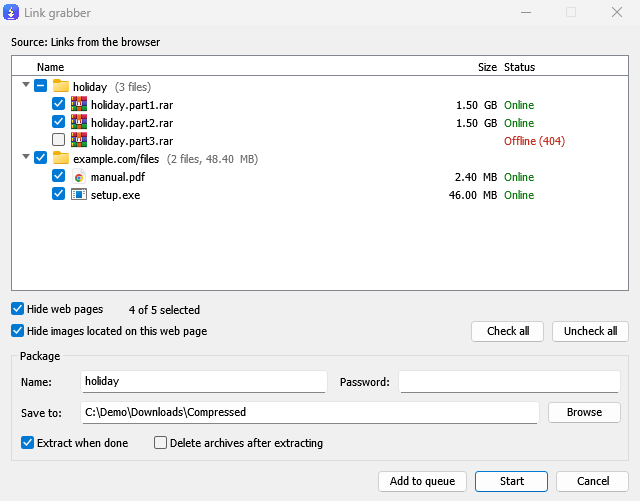
The downloads join the Main download queue, ready to start (Start starts it too). Tasks → Import → From IDM export file reads an .ef2 file, with each download's referrer and cookies, and the file name a list gives it in a filename: line.
Tasks → Link grabber... opens the same window empty: paste text with links in it (Ctrl+V). See Link grabber and archives for the packages, the archive password and extracting archives when they are downloaded.
To save your own list, use Tasks → Export → To text file (one address per line) or To IDM export file.
When the address is already in the list
By default VDM asks what to do when you add an address it already has. You can choose a fixed answer in Options → Downloads → If a duplicate download link is added:
- Show a dialog and ask what to do.
- Add the duplicate with a numbered file name
- Add the duplicate and overwrite the existing file
- If existing file is complete, show download complete dialog; otherwise resume it.
Next steps
- Send browser downloads to VDM →
- Watch a download in the progress window →
- Queue downloads for later →
Free, open source, no ads, no trial.
Download Volt Download Manager